
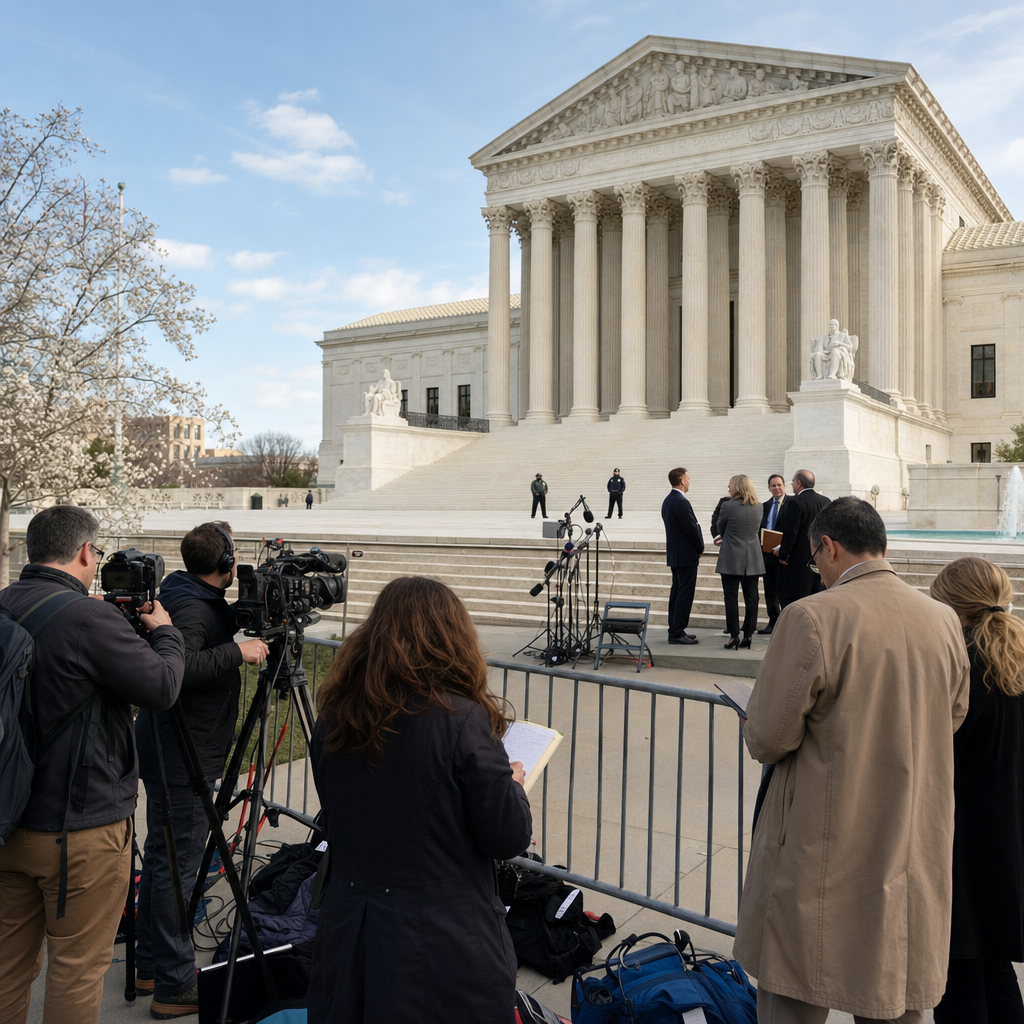
The U.S. Supreme Court on Tuesday sided with the Trump administration in a legal challenge concerning a policy that limits what federal immigration judges can publicly say about immigration. However, the ruling did not delve into the constitutionality of the speech restriction itself, which was initially imposed in 2017 during Trump’s first term. The decision potentially allows an association representing the judges to continue their legal fight in a lower court.
The Trump administration had appealed to the Supreme Court after the 4th U.S. Circuit Court of Appeals in Richmond mandated an inquiry into whether Trump’s dismissal of leaders at agencies overseeing federal employee complaints had compromised their intended independence from White House control. The 4th Circuit believed such a finding might grant the immigration judges direct access to court, rather than forcing their grievances into agency proceedings, which the Trump administration advocated for.
In an unsigned decision, the Supreme Court reversed the 4th Circuit’s ruling and returned the case for further proceedings. The justices criticized the 4th Circuit for basing its ruling on an argument not presented by the National Association of Immigration Judges, thereby violating the ‘party-presentation’ principle.
Alex Abdo, a lawyer with the Knight First Amendment Institute representing the association, expressed his disappointment with the outcome. He stated that ‘forcing public employees to wade through cumbersome and potentially futile administrative proceedings before challenging prior restraints allows unconstitutional censorship to persist.’ Abdo emphasized the importance of insights from immigration judges and other public employees for understanding government operations.
The policy at the heart of the dispute requires immigration judges to obtain prior approval for any ‘official’ statements. These ‘official’ engagements are defined as instances where a judge is invited due to their official position, is expected to discuss agency policies or matters related to their duties, or otherwise represents the agency, according to court documents.
The association filed a lawsuit in 2020 to block the policy, arguing it infringes upon the U.S. Constitution’s First Amendment protections for free speech. The Executive Office for Immigration Review, which employs approximately 750 immigration judges and manages the nation’s immigration courts, instituted the policy. It was subsequently reviewed and maintained by both the Biden and current Trump administrations.
In 2023, a federal judge in Virginia dismissed the court challenge, asserting that the 1978 Civil Service Reform Act mandated that such challenges be addressed by independent U.S. agencies handling federal worker complaints, rather than in court. Under this law, certain federal employee complaints are reviewed by the Office of Special Counsel, which determines whether to refer the case to the Merit Systems Protection Board for adjudication.
However, the 4th Circuit last year argued that Trump’s firings of agency heads raised significant questions about the immigration judges’ ability to receive a fair hearing from these agencies. It instructed the judge to conduct fact-finding on this issue, which prompted the Trump administration’s appeal to the Supreme Court.
Trump has previously removed numerous independent agency heads despite legal protections designed to shield these officials from being arbitrarily dismissed. The Supreme Court is also expected to rule by late June on the Trump administration’s argument that such removal protections unconstitutionally limit presidential power. The Supreme Court has previously supported Trump in several emergency immigration-related rulings since his return to the presidency, including decisions permitting him to deport migrants to countries other than their own and to revoke temporary legal status for hundreds of thousands of Venezuelan immigrants. Additionally, the court is expected to rule by the end of June on the legality of Trump’s directive to restrict birthright citizenship in the U.S. and the administration’s attempt to revoke temporary legal protections for over 350,000 Haitians and approximately 6,100 Syrians residing in the country.