

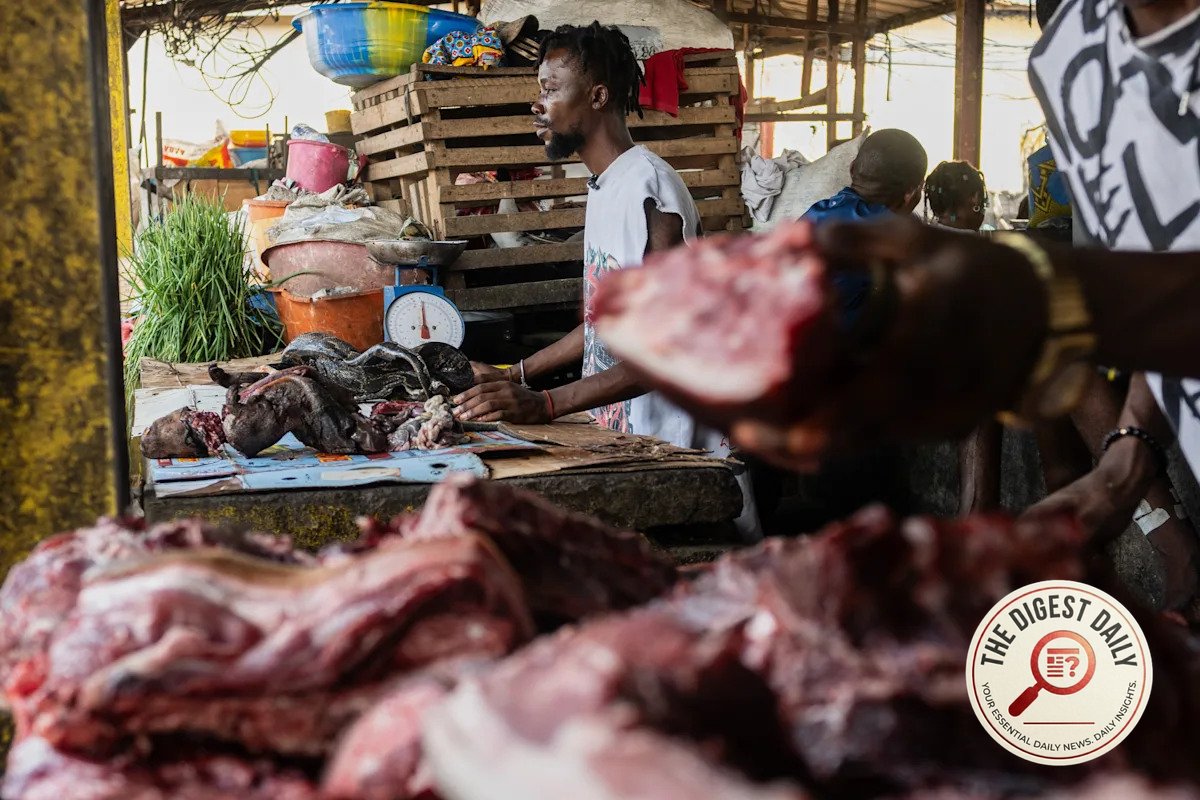
Under the heavy, humid air of Kinshasa’s Masina Market, the trade is done in whispers. You don’t just grab a slab of meat; you ask. Maybe you want a giant swamp rodent, or perhaps the severed leg of an antelope. It is a shadow economy of appetite. Nearby, women sit over massive baskets of writhing caterpillars, selling them in the open.
For millions in the Congo Basin, wild meat—known locally as “viande de brousse”—is not just food. It is a craving. It is culture. Not even Ebola, currently tearing through the country’s eastern forests, can stop the trade. This massive forest ecosystem, often called the planet’s second lung, is teeming with life. And death. Hunters target everything from great apes to pythons, exposing themselves to a lethal cocktail of animal-borne pathogens.
Ebola is not a foodborne illness in the traditional sense. But butchering a carcass? That is where the virus finds its bridge. Blood meets blood. The U.S. CDC warns that handling, hunting, and prepping infected meat is a direct ticket to infection. Dr. Tolbert Geewleh Nyenswah of the Africa Centres for Disease Control and Prevention points to the messy collision of humans, animals, and the wild. “We still interact with the bats,” he warns. Hunters still kill monkeys. The barrier is gone.
The numbers are grim. Since declaring an outbreak on May 15, the Congolese government has logged over 1,000 suspected cases. At least 220 people are dead. The World Health Organization fears the real toll is much higher, masked by weeks of silent spread. This is the Bundibugyo strain. It is rare. It has no approved vaccine. To make matters worse, the outbreak is unfolding in a war zone, complicated by rebel violence and mass displacement.
Ebola is an old ghost. First identified in 1976 near the Congo River, it usually starts when a virus jumps from a host, like a fruit bat, to a human. Yet, because these spillovers are sporadic, denial runs deep. Dr. Misaki Wayengera, an epidemic advisor to Uganda’s Ministry of Health, says many locals simply reject the connection. Some are ignorant. Others are stubborn. Changing ancient habits is a losing battle. The price of this denial is paid in blood. The 2014-2016 West African epidemic killed over 11,300 people. Still, the appetite remains.
The scale is staggering. Around 4.5 million tons of wild meat are pulled from the Congo Basin every year. It is the primary protein source for millions. It even ends up on the menus of high-end restaurants. Meanwhile, conservationists like Gladys Kalema-Zikusoka urge for basic education. People must learn that eating dead animals found in the forest is a death sentence. But try telling that to the vendors. In Masina Market, Charles Ntanga swats flies off a rancid rodent carcass. He sells it for $17 a kilo. Another vendor, Guyva Mputu, sells python meat that steams in the heat. They claim they no longer sell monkey. But they won’t stop selling. “We make our lives through this business,” Ntanga says. In a place where poverty is the daily reality, the threat of a virus tomorrow cannot compete with the hunger of today.