

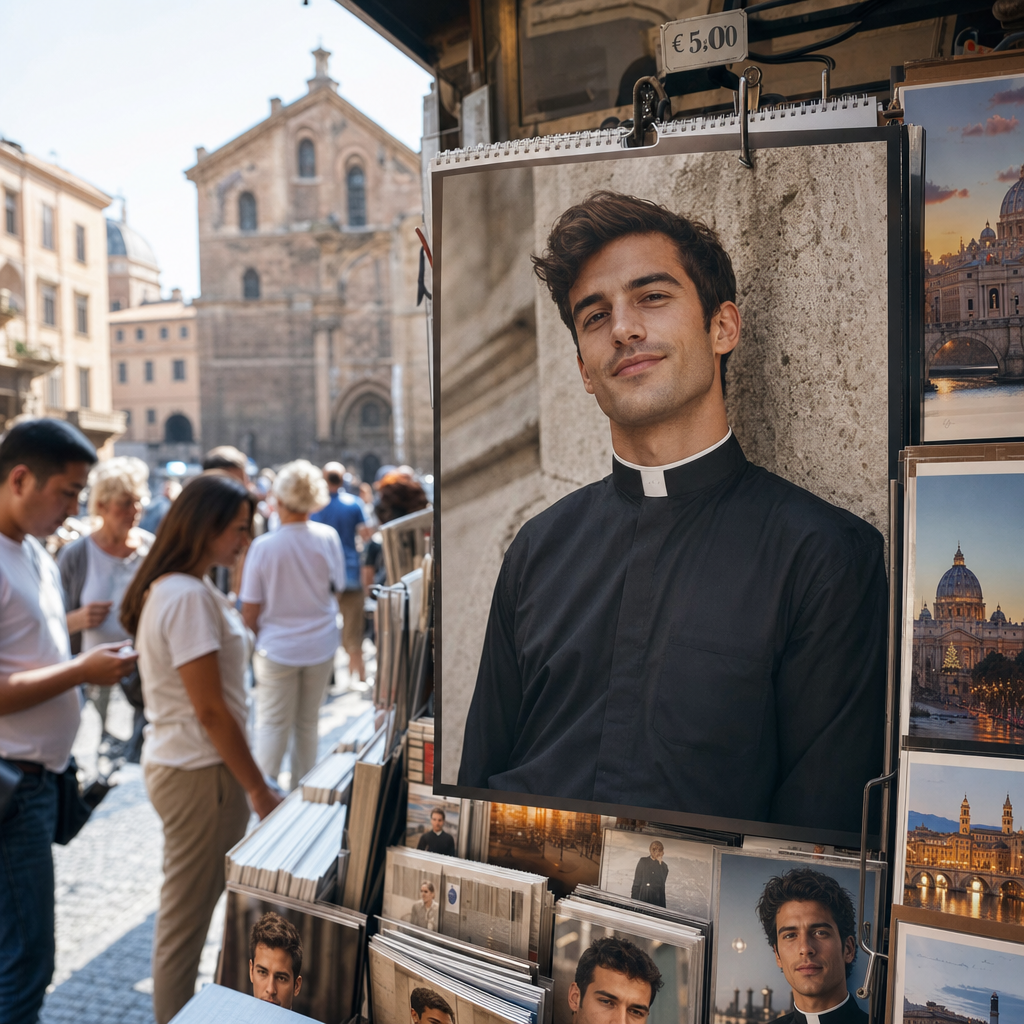
ROME (AP) — For two decades, a calendar showcasing appealing young men in priestly attire has been a popular souvenir in Rome. However, it appears that very few of these individuals are actual men of the cloth.
Giovanni Galizia has graced the cover of this ‘sexy priest calendar’ for many of its 23 editions. The same photograph, reused year after year, depicts Galizia in a clerical collar, exhibiting an enigmatic, Mona Lisa-esque smile against the backdrop of a granite church wall in his native Palermo.
“It was the smile of an embarrassed boy, as all my friends were standing in front of me, laughing because I was dressed like a priest,” Galizia recounted to The Associated Press during a recent interview in his Verona living room.
For Galizia, the photoshoot was a fleeting diversion that had no lasting impact on his life until a story in the Rome daily La Repubblica revealed this week that the “sexy priest calendar” could be more accurately dubbed “the fake priest calendar,” sparking widespread national attention. The Vatican, which declined to comment, is not affiliated with the calendar.
Now a 39-year-old flight attendant for a Spanish airline, Galizia was merely 17 when mutual acquaintances connected him with photographer Piero Pazzi. Pazzi is also known for a calendar featuring Venetian gondoliers and has established museums dedicated to the history of cats in Budapest and Montenegro.
The calendar, officially named Calendario Romano, presents 12 black-and-white portraits, primarily of men in clerical garments, many of which are re-used annually. Galizia only recognized one other subject, a Frenchman who was also not a priest. Pazzi informed the AP that at least a third of the subjects in the upcoming 2027 calendar are indeed priests, though he offered no further details. Galizia mentioned he has never been recognized on the street, although his cousins once gifted the calendar to their grandmother, leading to much amusement.
Galizia views the photographs of individuals dressed as priests as part of an artistic tradition, similar to how no one believes actors portraying clergy in a TV drama are actual priests. “Naturally, it subtly plays with the dynamic between the sacred and the profane, because it’s clear that seeing a world as distant and in some ways as elevated as the ecclesiastical world, with such a fresh-faced young man, creates a kind of dissonance,” he explained. However, he also expressed confusion as to why the black-and-white close-ups have been perceived as sexy. Pazzi likewise stated that sensuality was not the intention.
“There’s a tendency to conflate beauty with sensuality, particularly in today’s rather sexualized world, where beauty is often expressed solely through sensuality,” Galizia observed. “That said, I appreciate the comment and take it as a compliment — as managing to be sexy in a priest’s collar is no small feat.”
Pazzi refrains from disclosing the total number of Calendario Romano copies sold, but estimates several thousand yearly. While Pazzi receives royalties, Galizia, who signed a release form at the time of the photo, stated he has never sought payment.
The calendar retails for about 8 euros (approximately $9.30) in shops near the Vatican and throughout Rome’s historic center. Hassam Mohammad, a shop clerk, noted that he sells a few handfuls daily. Pazzi includes a page of Vatican-related information in the calendar, but its production is entirely independent of the Holy See.
A South Korean priest, informally identified as Father Domenico, walking near the Vatican this week, mentioned that the calendar is well-known in his home country, particularly among young people who view it light-heartedly. “They often perceive priests as rigid and aloof,” he said. “But looking at this calendar, they feel priests are more relatable and can even be humorous. I believe in Korea, this calendar is very popular, and it’s okay.”