
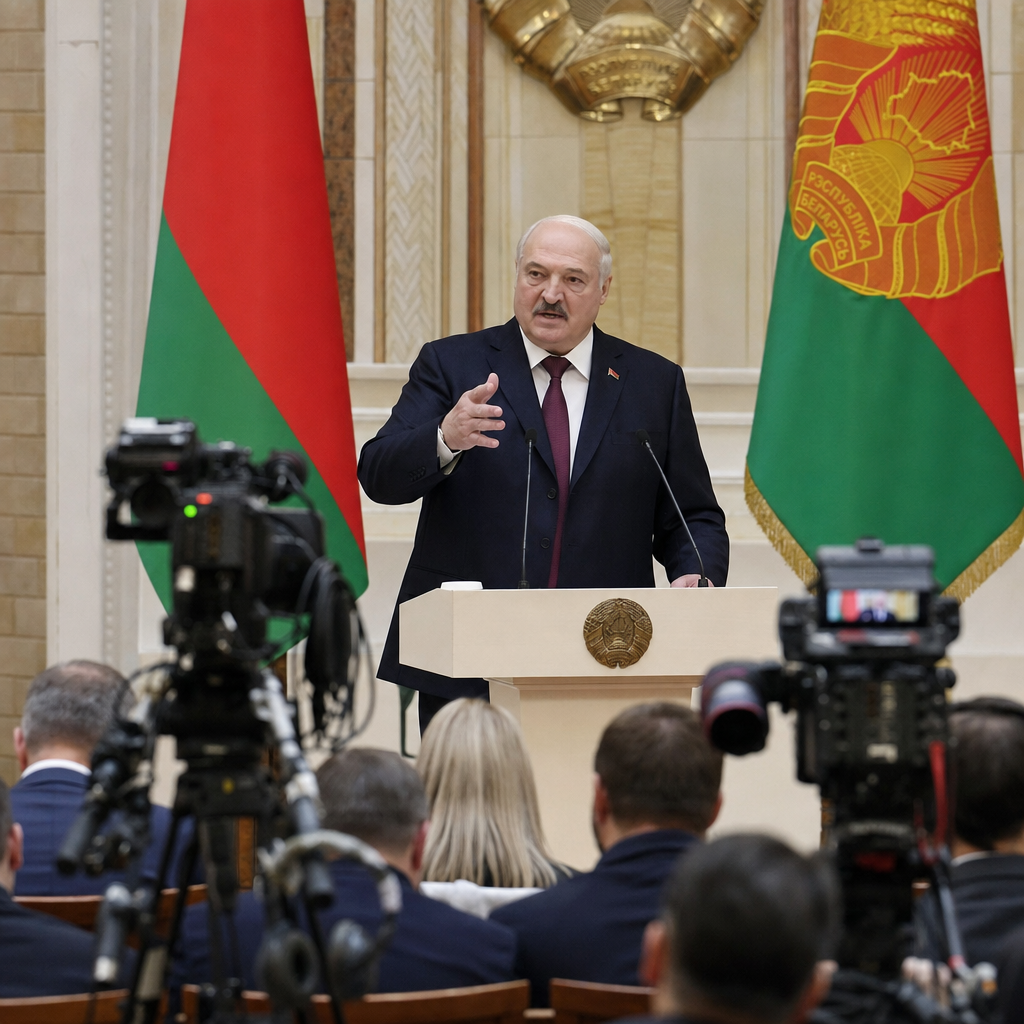
MINSK, May 21 (Reuters) – President Alexander Lukashenko of Belarus recently stated that his nation would not be drawn into the ongoing conflict in Ukraine, while underlining that Belarus and Russia are prepared to co-defend their territories against any aggression, as reported by the Belarusian state news agency BELTA.
BELTA also relayed Lukashenko’s openness to a meeting with Ukrainian President Volodymyr Zelenskiy, despite Zelenskiy’s repeated concerns about Belarus’s potential deeper involvement in the conflict, now in its fifth year.
These comments were made during joint nuclear exercises with Russia, which Lukashenko and Russian President Vladimir Putin observed remotely through a video conference.
“Regarding [Zelenskiy’s] assertions that Belarus will be pulled into the war, as I’ve just stated, this would only happen under one specific condition — if aggression targets our territory,” BELTA quoted Lukashenko. “We will collectively defend our homeland… where both our countries stand.”
He further indicated that if Zelenskiy wishes to “discuss various matters, engage in dialogue, or perhaps something else, we are absolutely open to it. Any location — Ukraine, Belarus — I am ready to meet him and address issues in our relationship.”
Belarus granted Russia access to its land for the full-scale invasion of Ukraine in February 2022, prompting weeks of warnings from Zelenskiy regarding unusual activities and potential cross-border incursions.
On the same day, Zelenskiy reportedly convened with officials in northern Ukraine, near the Belarusian border, to discuss strengthening defenses.
In his nightly video address, Zelenskiy asserted that Russia was “eager to pull Belarus further into this war,” and vowed that Ukraine possessed “the capacity to enhance our defenses… and to act preventively.”
Lukashenko and Belarus have faced Western sanctions for alleged human rights violations and for assisting Russia’s 2022 invasion of Ukraine.
However, the United States has held discussions with Belarus, leading to the release of numerous individuals considered political prisoners by Western nations, in exchange for the relaxation of certain sanctions. U.S. envoy John Coale has suggested that Lukashenko might soon visit the United States.
In his remarks, Lukashenko implied that European leaders, uneasy with the prospect of improved relations between Washington and Minsk, might have instigated Zelenskiy’s recent allegations.
“They observe that we are engaged in a particular dialogue with the Americans,” BELTA cited him, “And not everyone approves of that. And consequently, they are influencing Zelenskiy.”
(Reporting by Reuters, Writing by Felix Light; editing by Vladimir Soldatkin, Ron Popeski and Alistair Bell)