

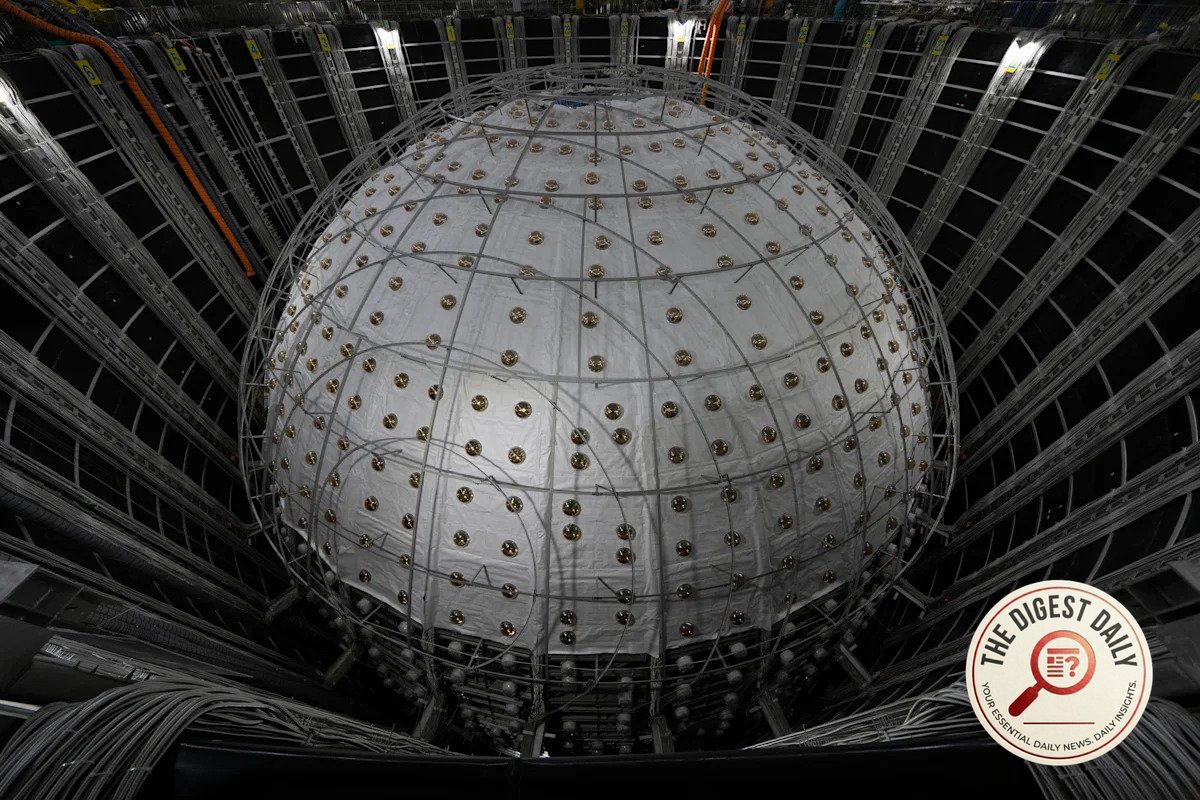
Deep beneath the dirt in China, a massive, expensive sphere is looking for ghosts. They call them neutrinos. Trillions of these subatomic particles scream through your body every single second, leaving absolutely no trace. They weigh next to nothing. They are incredibly hard to catch. But on Wednesday, the team behind the Jiangmen Underground Neutrino Observatory (JUNO) dropped their first real batch of data in the journal Nature.
It is a modest beginning. Just two months of data, actually. Yet, the JUNO team claims they have already mapped some of the most precise measurements ever recorded of how these slippery little particles morph between three different “flavors” as they hurtle through the void. Physicists are thrilled. “It really makes me look forward to more exciting results,” muttered Kate Scholberg, a Duke University physicist who has no skin in this particular game.
The hardware is buried deep. Seven hundred meters down, to be exact, shielded from the noisy cosmic radiation of the surface. JUNO is essentially a giant eye waiting for a spark. It watches for antineutrinos—the antimatter twins of our ghostly friends—spewed out by two nearby nuclear power plants. When one of these phantom particles slams into the liquid inside the detector, it produces a tiny, telltale flash of light. That flash is everything.
The ultimate goal is a heavy-weight fight. Literally. Scientists know there are three neutrino flavors, and they know they have different masses. But they do not know the order. Is it two heavyweights and a lightweight, or the other way around? JUNO hasn’t cracked that nut yet. Still, co-author Liangjian Wen insists the machine is sensitive enough to feel the “finer ripples” of these quantum shifts. They had better hurry. In the next decade, rival detectors in Japan and the United States will turn on, ready to steal the spotlight.