

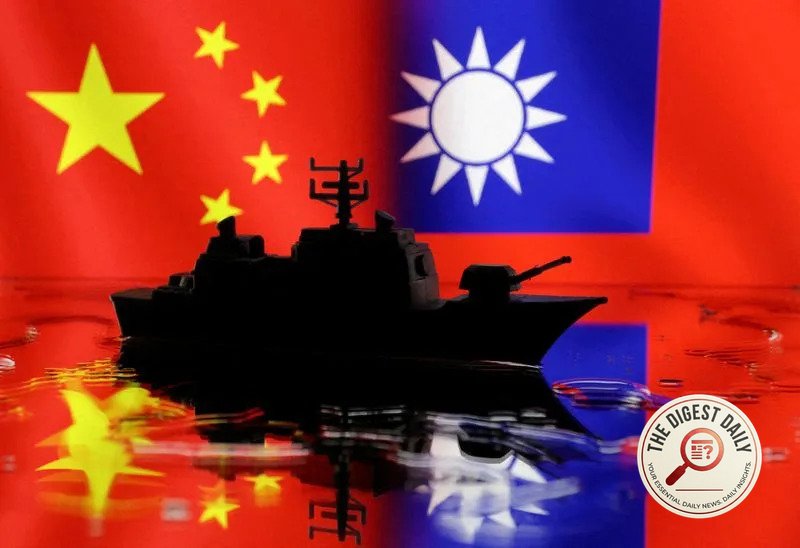
Beijing is playing its favorite game of maritime chicken again. On Saturday, China announced another coast guard patrol deployed just east of Taiwan. It is a calculated move. It comes hot on the heels of a similar stunt last month that had Western diplomats sweating.
We see this daily. China’s military constantly buzzes Taiwan, a democratic island Beijing desperately claims as its own property. But lately, the tactics have shifted. Instead of just sending fighter jets, Beijing is weaponizing its coast guard. Taiwan calls it “lawfare.” It is a thin bureaucratic veneer used to justify raw territorial expansion.
China’s Coast Guard issued a predictably stiff statement. They claim these “law enforcement patrols” will protect what they call Chinese jurisdictional waters. They vowed to firmly safeguard sovereignty.
Taipei is not buying the legal theater. Taiwan’s government immediately blasted the patrol as an illegal power grab that trashes international law and wrecks regional stability. The Mainland Affairs Council, which handles Taiwan’s cross-strait policy, pointed out the obvious. They stated flatly that Chinese communists have zero sovereignty, zero jurisdiction, and zero law-enforcement authority in the waters east of Taiwan.
Taiwan’s own coast guard is currently shadowing two Chinese vessels. By mid-morning, the intruders were sitting 54 nautical miles east of Hualien. That is a sensitive spot. Hualien hosts a major Taiwanese air base. While the Chinese ships stayed just outside restricted waters, Taipei is not taking chances. They promised to use all necessary force to kick out any harassing vessels.
This is the second time in a month Beijing has pulled this stunt on Taiwan’s eastern flank. It is a dangerous escalation. The drama is already dragging in heavy hitters like the U.S., France, Germany, and Britain.
Beijing claims its previous June operation was a reaction to Japan and the Philippines discussing maritime boundaries. China, naturally, thinks those waters belong to them.
Taiwanese authorities are telling their civilian ships to ignore any Chinese boarding demands. If Chinese officers try to flex their muscles, Taiwan’s own coast guard promises to step in.
Meanwhile, Beijing keeps churning out paperwork to justify the bullying. On Thursday, China’s Ministry of Natural Resources dropped an English-language “legal opinion” warning Japan and the Philippines to talk to Beijing, not Taipei, and telling the rest of the world to stay out of it. It is the classic Beijing playbook: write the rules, ignore the law, and see who blinks first.