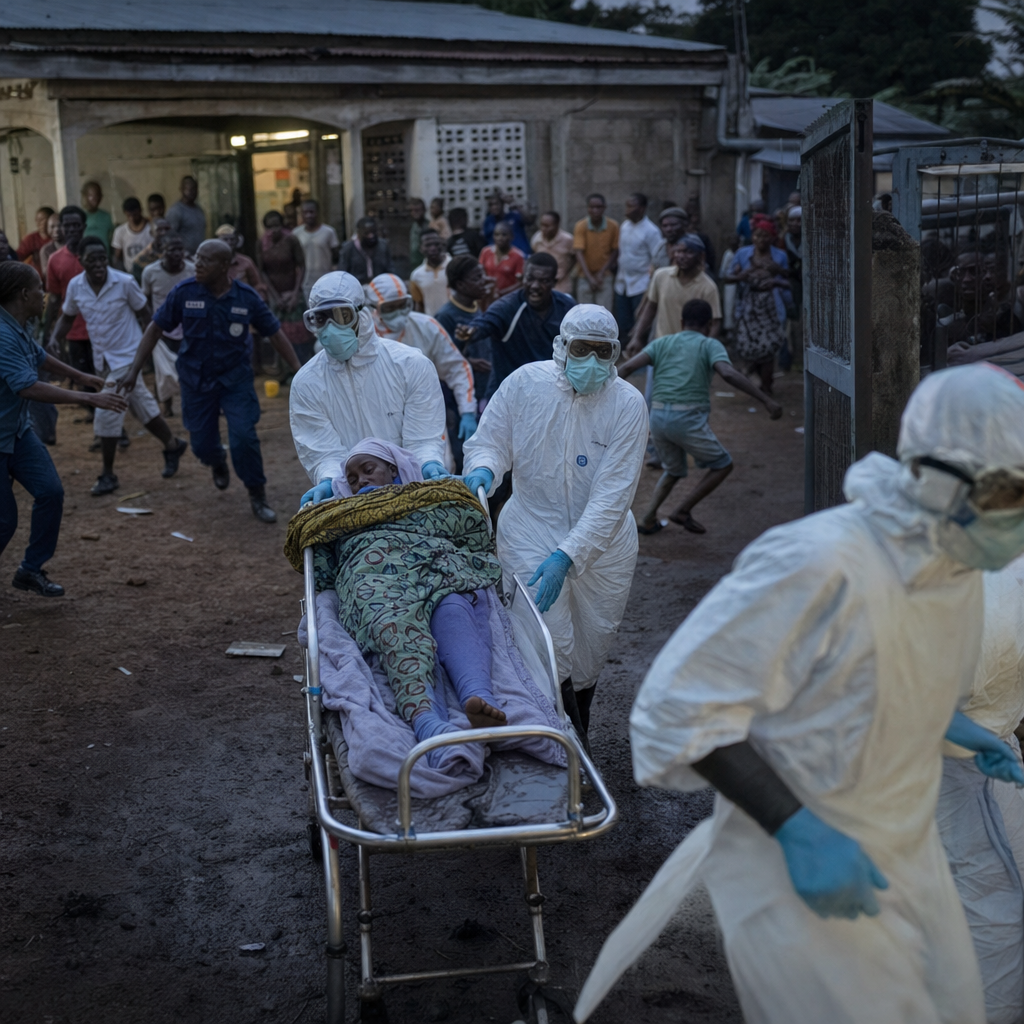

KINSHASA, Congo (AP) — A group of distressed young men reportedly stormed a facility treating Ebola patients in eastern Congo on Sunday evening, leading to the rapid evacuation of medical personnel and patients as gunshots were heard in the vicinity. The incident occurred at Monbgwalu General Hospital, located in the epicenter of the most recent Ebola outbreak. Dr. Richard Lokudu, the hospital’s medical director, informed The Associated Press that the assailants demanded the release of two bodies belonging to their relatives. While the extent of injuries, if any, resulting from the attack on Monbgwalu General Hospital remains unclear, Lokudu confirmed that the facility was placed on general alert as medical staff worked to remove patients and personnel from danger amidst the gunfire. He was unable to provide additional details regarding the chaotic situation. This incident marks the third attack within a week on healthcare facilities struggling with inadequate resources to manage suspected Ebola cases. Such challenges highlight the immense difficulties surrounding the outbreak, which the World Health Organization has deemed a public health emergency of international concern. The remains of individuals who have succumbed to Ebola can be highly infectious, potentially leading to further transmission during traditional burial preparations and funeral gatherings. Consequently, Congolese authorities have mandated that the hazardous task of burying suspected victims be handled by official bodies whenever feasible, a policy that has, at times, met with resistance from families and communities. To combat the virus’s spread, the government announced on Friday a ban on funeral wakes and gatherings exceeding 50 people in northeastern Congo. Just a day prior, residents of Mongbwalu reportedly attacked and set fire to a tent established by Doctors Without Borders for confirmed and suspected Ebola patients. Dr. Lokudu had previously stated that during that assault, 18 individuals with suspected Ebola infections fled the facility and their whereabouts are currently unknown. Furthermore, on Thursday, a separate treatment center in Rwampara was torched after family members were prevented from retrieving the body of a local man believed to have died from Ebola. The WHO has elevated the risk posed by the outbreak for Congo to “very high” from a previous “high” classification, though it maintains that the global risk of propagation remains low. Earlier on Sunday, the Congolese Ministry of Communication reported on X that suspected Ebola cases had surged to 904, primarily in the northeastern Ituri Province, a considerable increase from the previously cited figure of over 700. The ministry also stated that suspected Ebola-related deaths totaled 119; however, the regional breakdowns provided summed to 220, a discrepancy for which officials were not immediately available to clarify. A rare strain of Ebola, the Bundibugyo virus, for which no vaccine is currently available, spread undetected for weeks in Ituri following the first reported fatality in late April in Bunia, the provincial capital. This occurred while authorities were testing for another, more common, Ebola virus, which yielded negative results. The International Federation of Red Cross and Red Crescent Societies disclosed on Saturday that three of its volunteers had died from the outbreak in Mongbwalu. The agency believes these healthcare workers contracted the virus on March 27 while handling deceased individuals as part of a humanitarian mission unrelated to Ebola. If confirmed, this would significantly alter the known timeline of the outbreak.