
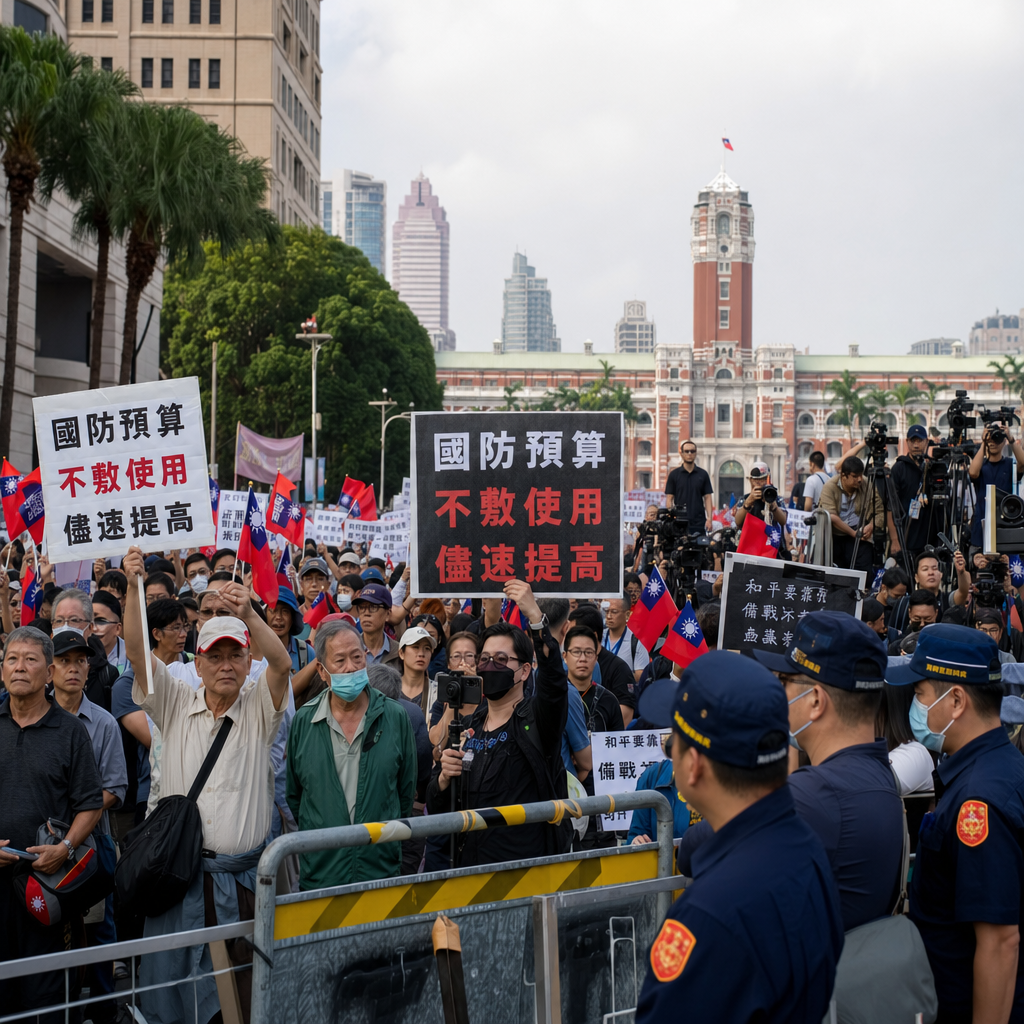
Hundreds gathered in central Taipei on Saturday to advocate for increased national defense expenditures, following a parliamentary decision to approve only two-thirds of the $40 billion requested by President Lai Ching-te. President Lai sought the supplementary defense budget to fund both U.S. arms procurements and domestically produced equipment, such as drones, aiming to strengthen Taiwan’s deterrent capabilities against China, which asserts dominion over the island.
However, the opposition-controlled parliament, holding the majority of seats, passed an alternative spending package earlier this month. This revised version exclusively allocated funds for U.S. weaponry, with the opposition citing concerns over the clarity of the government’s proposals and potential for corruption.
The demonstration in Taipei was orchestrated by various human rights organizations and pro-independence factions. Participants brandished flags and chanted slogans, voicing their support for augmented defense spending. Wang Hsing-huan, chairman of the Taiwan Statebuilding Party—a smaller party without parliamentary representation—addressed the crowd, stating, “Genuine peace necessitates national defense. Only by reinforcing our national defense can we guarantee Taiwan’s freedom.”
The government is currently endeavoring to secure approval for the remaining funds, which include allocations for its new “T-Dome” integrated air defense system. Angela Yen, a 34-year-old civil engineer, commented, “We must safeguard ourselves against China’s expansion. China and Taiwan are distinct nations.”
While Taiwan’s primary opposition parties affirm their support for defense spending, they emphasize their reluctance to issue “blank cheques.” Cheng Li-wun, chairwoman of the Kuomintang, the largest opposition party, remarked in southern Taiwan earlier Saturday that no one desires a conflict with China. Her party quoted her as stating that Taiwan, despite its financial resources, must avoid imprudent spending. Cheng, who recently met with Chinese President Xi Jinping in Beijing last month, further suggested that Taiwan should prioritize investments in peace rather than war, thereby sparing the next generation from military service.
Taiwan’s government consistently refutes Beijing’s sovereignty claims, asserting that only the populace of the island can determine its future.