

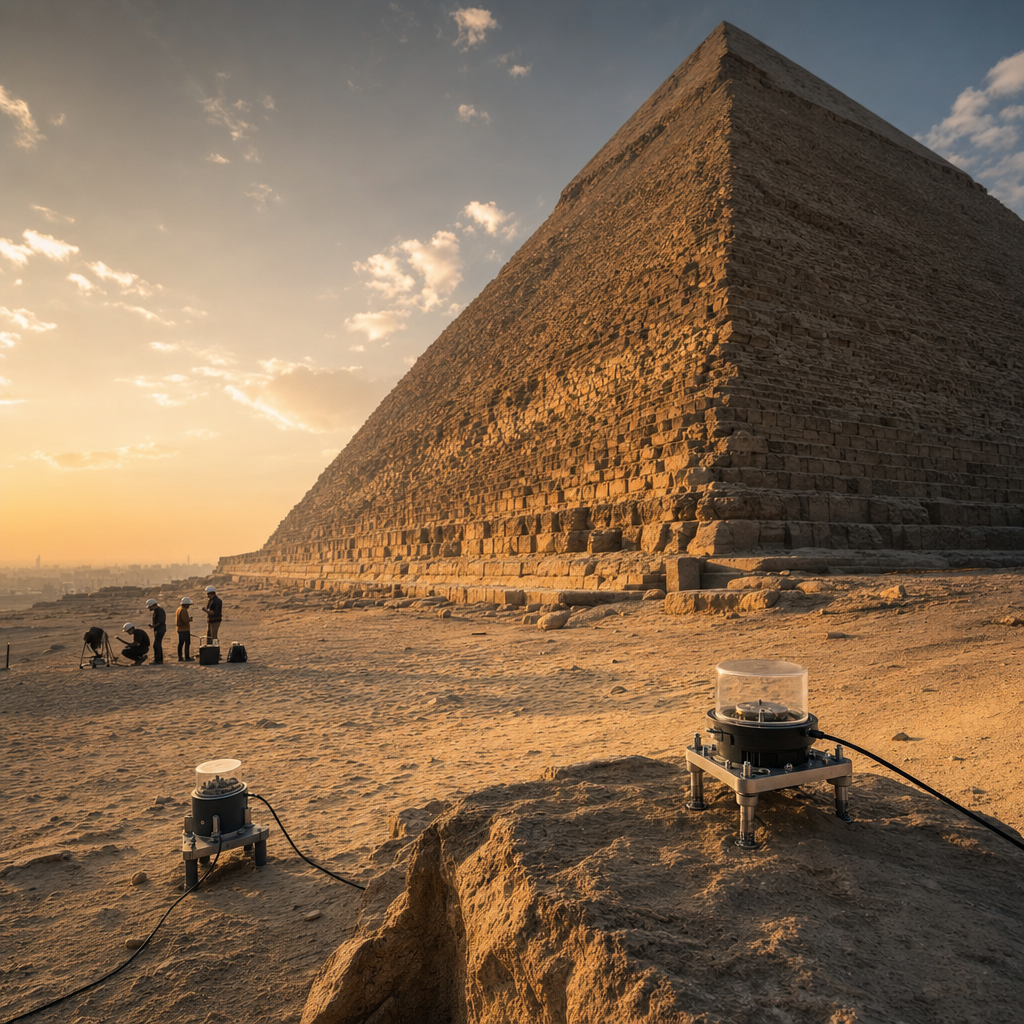
The Great Pyramid of Giza stands as an unparalleled testament to human ingenuity and ambition, having endured millennia amidst the rise and fall of civilizations. Recent investigations have shed light on a crucial aspect of its extraordinary longevity: its sophisticated design incorporated features that enabled it to withstand the destructive forces of earthquakes for approximately 4,600 years, since its construction as the burial site for Pharaoh Khufu.
Researchers utilized seismometers to record ambient vibrations – subtle background tremors from natural and human activity – at 37 locations both within and around the pyramid. This analysis revealed a remarkably uniform and stable structural response to these vibrations, especially considering its immense scale and intricate construction.
The pyramid, situated on the outskirts of Cairo, Egypt, is composed of colossal limestone blocks. Each of its four sides spans about 755 feet (230 meters) at the base, encompassing an area of approximately 13 acres (5.3 hectares). While its original height reached about 480 feet (147 meters), erosion and the historical removal of its smooth casing stones for building materials have reduced it to its current stature of around 455 feet (138.5 meters). For an astonishing 3,800 years, it remained the tallest structure globally.
Several characteristics contribute to the pyramid’s remarkable earthquake resistance. These include an exceptionally broad base, a low center of gravity, highly symmetrical geometry, a gradual decrease in mass towards the summit, and a complex internal layout featuring chambers designed to dampen vibration amplification. Furthermore, it was erected upon robust limestone bedrock.
Mohamed ElGabry, a seismologist at Egypt’s National Research Institute of Astronomy and Geophysics (NRIAG) and lead author of the study published in Scientific Reports, noted, “These elements collectively form a well-balanced and cohesive structure.” NRIAG seismologist and senior study author Asem Salama added, “Ancient Egyptian builders clearly possessed practical knowledge concerning stability, foundation behavior, mass distribution, and load transfer.”
The study found that most vibrations recorded within the pyramid exhibited a frequency indicative of evenly distributed mechanical stress. Salama remarked, “While I’d hesitate to claim they intentionally engineered the pyramid specifically for earthquake resistance, I do believe they developed architectural and geotechnical solutions that inherently resulted in structures with exceptional long-term resilience.” This knowledge was likely acquired through extensive trial and error, a process evident in some less successful pyramids that predated this masterpiece.
Seismic data was gathered from various internal passages and chambers, including the primary burial chamber known as the King’s Chamber, as well as the surrounding bedrock and soil. The researchers observed that vibration amplification typically increased with elevation in tall structures. However, they identified a reduction in this amplification within five specialized chambers located above the King’s Chamber, despite their higher position. ElGabry explained, “This suggests these chambers effectively help dissipate seismic energy and protect the King’s Chamber – one of the most critical areas – from excessive shaking.”
Historical seismic events, such as significant earthquakes in 1847 and 1992 (which caused severe damage to thousands of buildings and resulted in over 560 fatalities in the latter instance), reportedly caused minimal damage to the pyramid. The Great Pyramid is part of a broader complex, alongside other pyramids and the Great Sphinx of Giza, which has attracted countless visitors since antiquity.
ElGabry praised the structure not just as an engineering marvel, but as “a profound work of art and human vision. Its perfect symmetry, monumental scale, and elegant proportions create a timeless beauty that continues to inspire awe even after 4,600 years.” He further expressed profound admiration for the project management and organizational expertise demonstrated. “Building such a monument took approximately 20 years and required sustaining a clear, long-term vision, an extremely complex supply chain, and the coordination of tens of thousands of skilled workers, engineers, and administrators,” he said. This monumental undertaking involved meticulous human resource management, specialized labor training, ensuring a continuous food supply for workers, and the logistical coordination of massive quantities of stone.
ElGabry concluded, “It reminds us what human civilization is capable of when vision, science, organization, and determination come together.” Salama concurred, stating, “They really did build ‘one for the ages’.”