

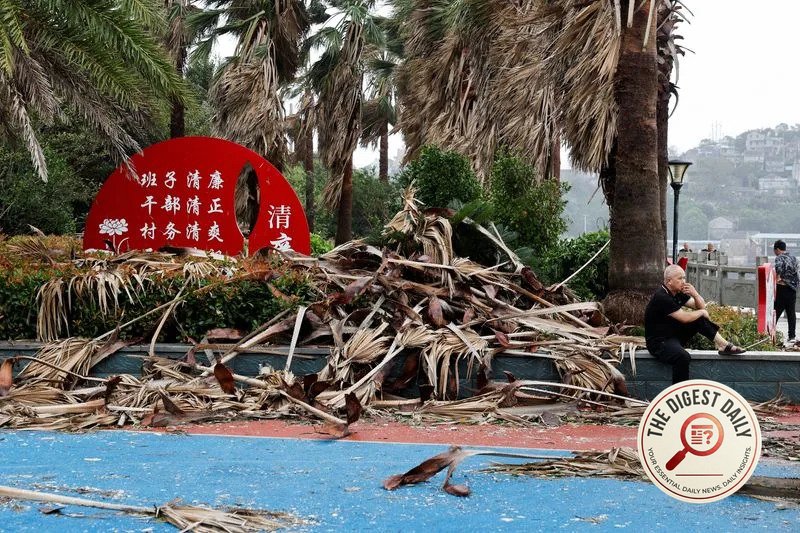
Nature doesn’t care about logistics. A massive deluge has forced over 260,000 residents out of their homes in China’s northeastern Liaoning province. Typhoon Bavi, the most ferocious tempest to slam the mainland this year, is the culprit.
The misery isn’t over. Forecasters warn that torrential downpours will hammer the region through Tuesday. Bavi is acting like a giant atmospheric vacuum, sucking up tropical moisture from the south and dumping it directly onto northern China’s saturated soil.
Chaos ruled the streets of Shenyang, the provincial capital. Social media footage captured a bizarre, dangerous scene: a lighthouse snapped its high-voltage power line and floated down flooded main avenues, drifting precariously under a bridge. It was surreal.
Local governments scrambled to react. Officials shut down all schools and training centers. Meanwhile, public transit ground to a halt across major northeastern hubs, leaving commuters stranded in Shenyang and Jilin.
This storm is a behemoth. Spanning an area roughly the size of France, Bavi first spun to life in the Pacific nearly two weeks ago. It slammed into eastern China on Saturday night, yet its core remained remarkably undamaged. It is now officially the longest-surviving tropical cyclone in the Asia-Pacific region for the year.
Why won’t it die? Meteorologists point to an unusually resilient warm core. This structural anomaly allowed Bavi to keep its moisture locked in as it marched toward the Korean peninsula. Now, as the tropical storm slows down, it is poised to dump those massive reserves of water all at once. Expect more wreckage.