

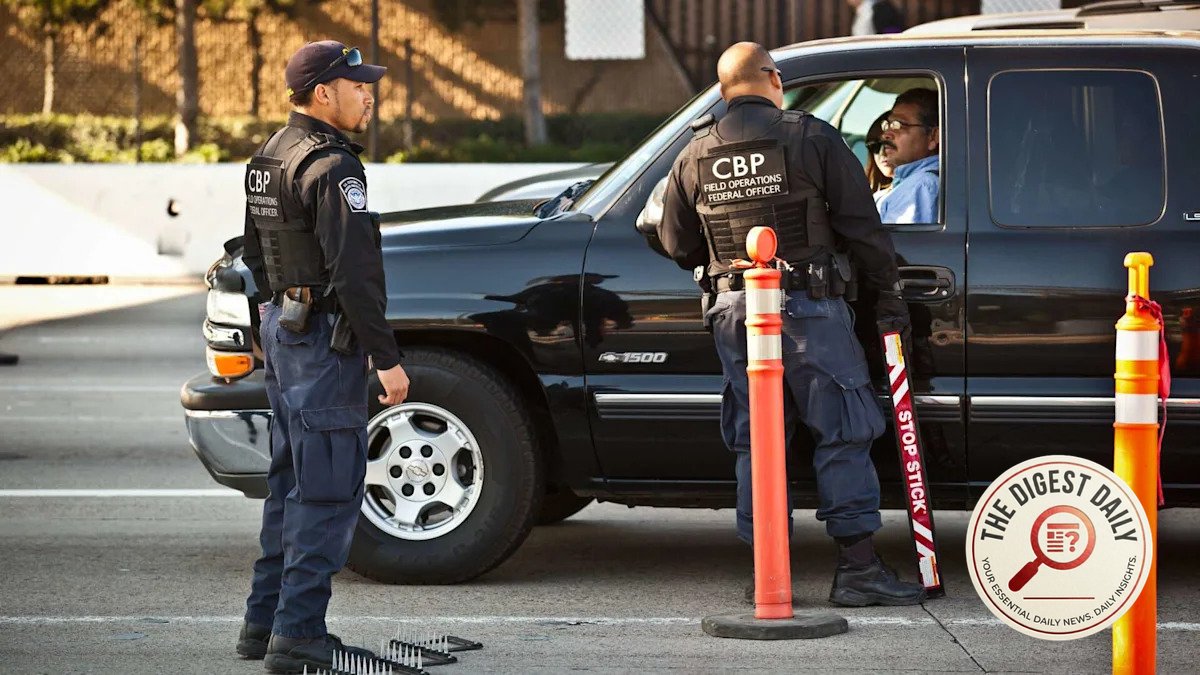
Picture this. You are heading home from a long-overdue European vacation. Or maybe you are just driving through a town eighty miles from the Canadian border. Suddenly, a federal agent demands your phone. They do not have a warrant. They do not even have a specific reason to suspect you of a crime. Under current federal policy, they do not need one.
Welcome to the “border search exception.” It is a legal loophole big enough to drive a truck through, and it covers a massive swath of the American population. Specifically, anyone within 100 miles of any U.S. border or international airport is fair game.
Wilmer Chavarria, a school superintendent from Vermont, decided he had enough of this overreach. Backed by the Pacific Legal Foundation, Chavarria is suing the Department of Homeland Security. His ordeal began at Houston’s George Bush Intercontinental Airport, where Customs and Border Protection (CBP) agents detained him for over four hours. They refused to let him leave until he unlocked his personal phone, tablet, and work laptop. When Chavarria protested that his work computer contained sensitive student records, agents told him flatly that his Fourth Amendment rights did not exist at the border. They even claimed his attempt to assert those rights was suspicious.
This is not an isolated abuse of power. It is official policy, and it is getting worse.
In fiscal year 2025, CBP conducted a staggering 55,318 electronic device searches. That is a massive spike from 2023, which saw 37,778 searches. Go back to 2015, and the number was a mere 8,500. While noncitizens bear the brunt of this, citizens are increasingly targeted. Over 13,000 Americans had their devices searched in 2025 alone.
A quiet policy update issued in early 2026 made the dragnet even wider.
Previously, guidelines targeted standard tech like phones and laptops. The new directive explicitly lists smartwatches, vehicle infotainment systems, drones, SIM cards, and GPS units. If it holds data, they want it.
They also made it easier to keep what they find. Under the old rules, if agents did not find probable cause of a crime, they had to delete copied data. Now, they can retain your digital information if they claim it might be relevant to “reasonably anticipated litigation.” That is a blank check for data hoarding.
Furthermore, the threshold for invasive “advanced searches”—where agents use specialized software to copy and clone your device—has been gutted. Previously, they needed “reasonable suspicion” of a crime. The new policy allows these deep-dive searches without any individualized suspicion at all, so long as the agency invokes a vague “national security concern.”
There are minor limits. Agents are only supposed to search data physically stored on the device, not cloud accounts. They are instructed to put devices in airplane mode to prevent remote access. But in the dark room of a border interrogation station, those rules offer cold comfort.
Our digital devices hold our entire lives. Our finances, our private conversations, our medical histories. Yet, according to the government, all of it is up for grabs the moment you get close to the edge of the map.