
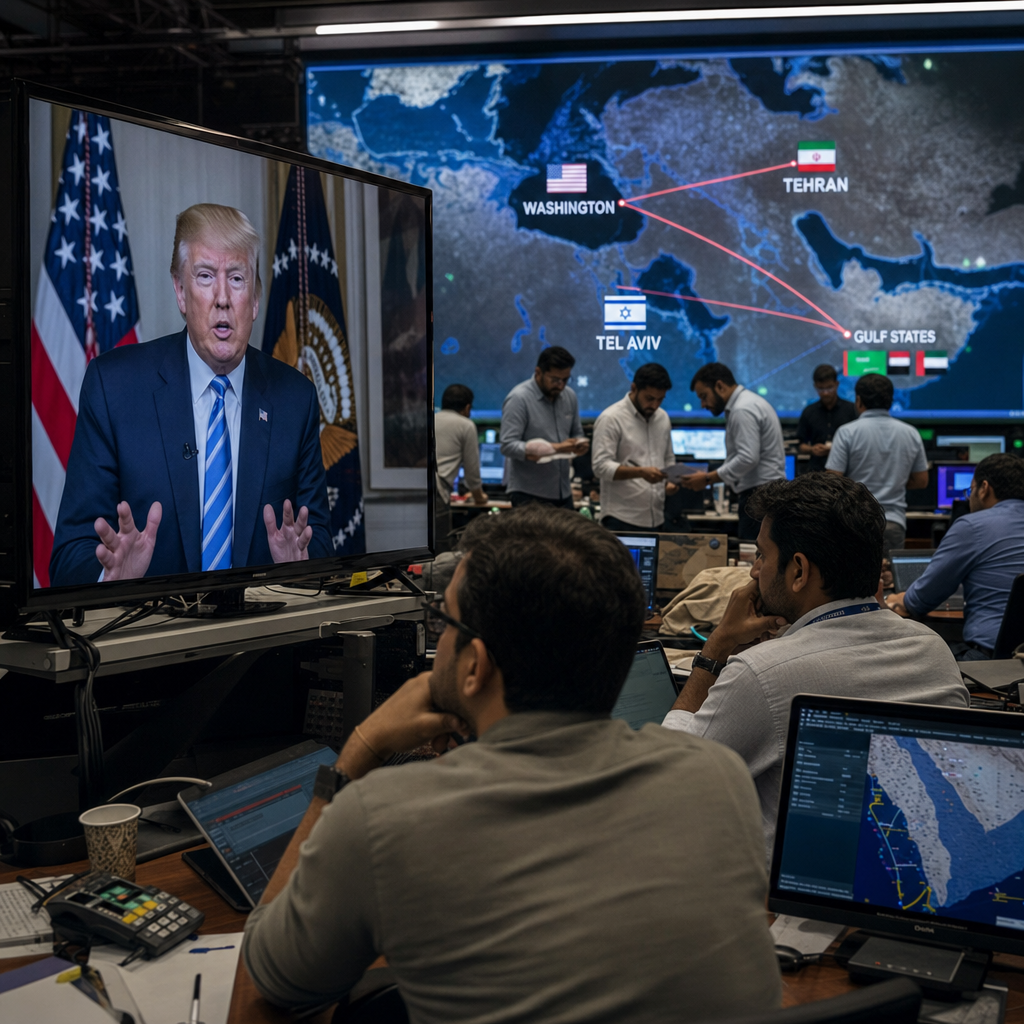
ISLAMABAD, Pakistan (AP) — President Donald Trump announced Saturday that a peace agreement with Iran, encompassing the highly contested opening of the Strait of Hormuz, has been “largely negotiated.” This declaration followed extensive phone consultations with Israel and other allied nations in the region.
“The final aspects and specific details of this Agreement are currently under discussion and will be unveiled imminently,” Trump stated on a social media platform, without providing further specifics. He detailed his discussions with leaders from Saudi Arabia, the United Arab Emirates, Qatar, Pakistan, Turkey, Egypt, Jordan, and Bahrain, as well as a separate conversation with Israel.
He characterized the understanding as a “Memorandum of Understanding related to PEACE” that still requires finalization by the United States, Iran, and the other nations involved in the discussions. This development comes at the conclusion of a week where the U.S. had contemplated a new series of military actions against the Islamic Republic, which would have jeopardized an already fragile ceasefire.
There was no mention of Iran’s nuclear program or its highly enriched uranium, issues that Iran has consistently sought to defer for later negotiation. Neither Iran nor Israel offered immediate comments. Trump reported that his conversation with Israeli Prime Minister Benjamin Netanyahu, who had previously advocated for military intervention, went “very well.”
Optimism had been growing among officials regarding a potential breakthrough.
Earlier on Saturday, a regional official with direct knowledge of the Pakistan-led mediation efforts indicated that the U.S. and Iran were nearing a resolution to the conflict.
The official, who requested anonymity due to the sensitive nature of the closed-door deliberations, cautioned that “last-minute disagreements” could still derail the efforts. This is not the first instance in recent weeks where a deal has been described as imminent.
According to the official, the proposed agreement would include a formal declaration of the war’s conclusion, with subsequent two-month negotiations focusing on Iran’s nuclear program. Furthermore, the Strait of Hormuz would be reopened, and the U.S. would lift its blockade on Iran’s ports.
Meanwhile, Iran had signaled “narrowing differences” during negotiations following additional discussions in Tehran involving Pakistani army chief Asim Munir.
On Sunday, Pakistan’s Prime Minister Shehbaz Sharif commended Trump’s initiatives to foster peace in the Middle East. He affirmed Pakistan’s unwavering support for peace efforts “with utmost sincerity” and expressed hope to “host the subsequent round of talks very soon.”
In a post on X, Sharif congratulated Trump for what he termed his “extraordinary efforts to pursue peace” and described the discussions among regional leaders as “highly beneficial and productive.”
Twelve weeks have passed since the U.S. and Israel’s assault on Iran on February 28, which resulted in the deaths of high-ranking Iranian officials, including its supreme leader, and temporarily halted nuclear discussions between the U.S. and Iran for the second time in less than a year. Iran subsequently retaliated against Israel and neighboring countries hosting U.S. forces, unsettling Gulf nations that had previously considered themselves secure within the volatile region.
A ceasefire has been in effect since April 7. However, Iran’s decision to effectively restrict maritime traffic through the Strait of Hormuz for vessels carrying regional oil, natural gas, and other vital commodities has emerged as a significant source of global concern and economic strain.
Iran characterized the understanding as a ‘framework agreement’ for future discussions.
Iran’s state television previously quoted Foreign Ministry spokesperson Esmail Baghaei as describing the draft as a “framework agreement,” adding: “We aim for this to encompass the primary issues necessary for ending the imposed conflict and other matters of crucial importance to us. Subsequently, within a reasonable timeframe, between 30 to 60 days, details will be deliberated, ultimately leading to a final agreement.”
He confirmed that the Strait of Hormuz is among the topics being discussed.
However, Baghaei informed Iran’s official IRNA news agency that nuclear issues are not part of the current negotiations.
“Our current focus is on bringing an end to the conflict on all fronts, including Lebanon,” he stated, emphasizing that the lifting of sanctions on Tehran “has been explicitly incorporated into the text and remains our steadfast position.”
The Iranian-backed Hezbollah’s Al-Manar TV reported that the leader of the Lebanese militant group received a letter from Iranian Foreign Minister Abbas Araghchi, affirming that Tehran would not abandon its allies. A delicate, U.S.-brokered ceasefire is currently in place in the Israel-Hezbollah conflict in Lebanon, a conflict that ignited two days after the war in Iran commenced.
Trump had previously indicated that “serious negotiations” were in progress.
Trump had earlier stated his decision to refrain from a military strike against Iran due to ongoing “serious negotiations,” undertaken at the request of Middle Eastern allies. Trump has a history of setting deadlines for Tehran only to subsequently withdraw them.
Iran’s parliament speaker, Mohammad Bagher Qalibaf, who served as the lead negotiator in the historic face-to-face talks with the U.S. last month in Islamabad, declared on Saturday that Iran has reconstituted its military capabilities, warning that any resumption of attacks by Trump would lead to an outcome “more devastating and more bitter” than at the onset of the war.
State television reported his comments after a meeting with Pakistan’s army chief, who also met with Araghchi, President Masoud Pezeshkian, and other senior officials. Qatar dispatched a high-ranking official to Tehran to support Pakistan’s efforts.
The stated objectives of the war have not been realized. Iran still possesses enriched uranium and maintains a missile program that it claims is being rebuilt. It continues to voice support for armed proxies throughout the region. The new supreme leader, though not yet seen publicly since the conflict began, is the son of the previous leader and maintains close ties with the influential Revolutionary Guard.
Furthermore, the Iranian populace has not revolted against the government, contrary to predictions made by both Trump and Netanyahu following nationwide protests earlier this year.
Magdy reported from Cairo and Superville from Washington. Associated Press writers Aamer Madhani in Washington and Bassem Mroue in Beirut contributed to this report.