
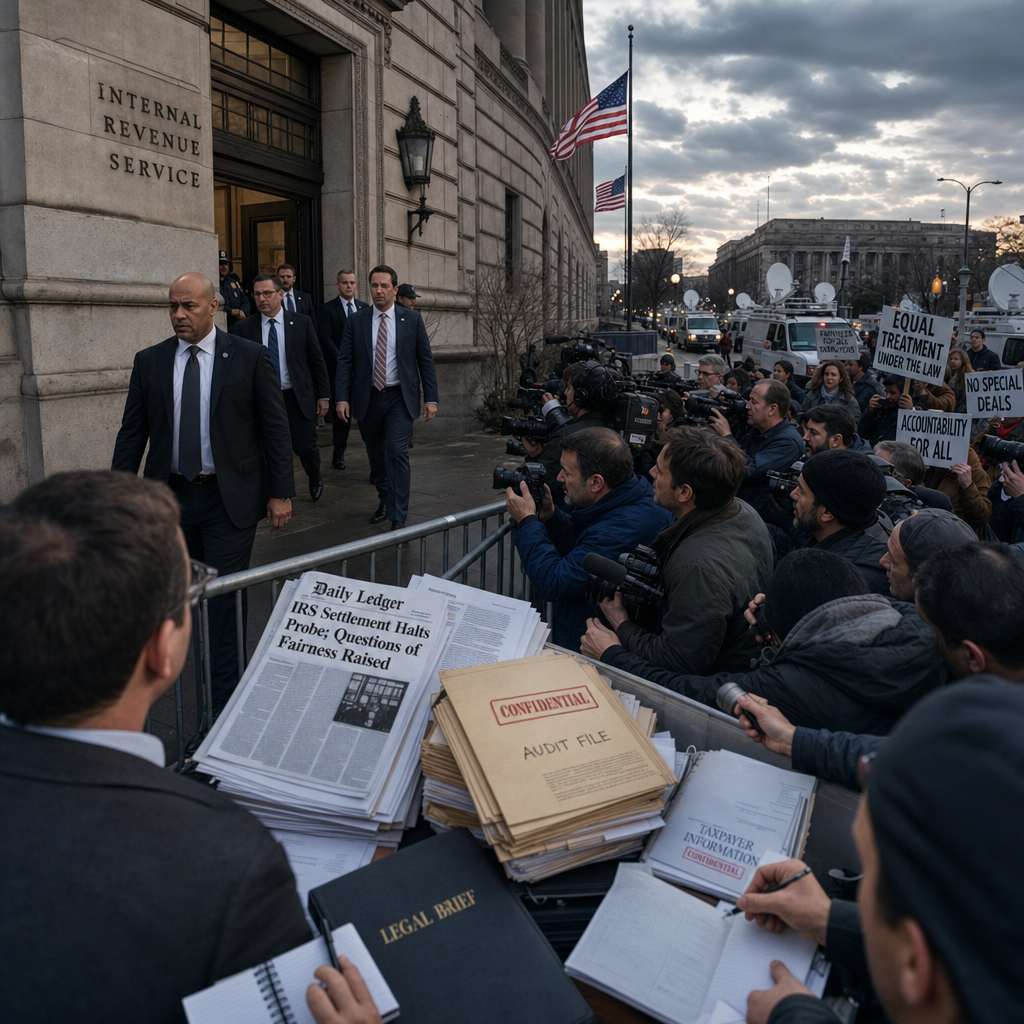
In a development that has raised eyebrows among tax experts, the Internal Revenue Service (IRS) has agreed to cease all ongoing investigations into Donald Trump regarding his tax obligations. This decision, part of a settlement stemming from a lawsuit filed by the former president over the unauthorized disclosure of his tax returns, could potentially include a long-standing audit concerning a specific tax maneuver. Reports suggest this audit might have resulted in a substantial assessment, potentially reaching $100 million, if the IRS had found improprieties.
Trump has consistently maintained his innocence, labeling the IRS investigations as politically motivated without offering substantiating evidence. While the details of IRS audits are confidential, the manner in which this case was resolved is being described by experts as highly unconventional. Trump initiated legal action against the IRS, an agency falling under the executive branch he once led. This move positioned him in the rare, and possibly unprecedented, situation of suing a component of his own administration. Subsequently, the agency, in another unusual step, granted him immunity.
The immunity agreement, part of a settlement to resolve Trump’s $10 billion lawsuit concerning the 2018 leak of his tax returns to The New York Times, stipulates that the U.S. government is “forever barred and precluded” from scrutinizing or prosecuting the current tax filings of Trump, his sons, and the Trump Organization. This provision was discreetly integrated into an initial settlement that established a $1.8 billion fund designed to compensate individuals Trump believes were improperly investigated by the government.
Tax professionals view this grant of immunity as astonishing given its extensive scope of protection for the former president, warning it could erode public confidence in the impartiality of the tax system. Daniel Werfel, a former IRS Commissioner, commented, “This is an unprecedented remedy,” emphasizing that Trump should be treated no differently than any other American. “People expect the same tax rules and enforcement framework to apply to everybody.”
The IRS investigation focused on allegations that Trump engaged in a form of double-dipping to reduce his taxes. A 2024 report by The New York Times and ProPublica highlighted claims that he utilized the same losses from his Chicago skyscraper on two occasions in subsequent tax filings—a practice strictly forbidden. The report further indicated that Trump could have owed over $100 million, including penalties, if the audit had concluded unfavorably for him.
Brandon DeBot, policy director at New York University’s Tax Law Center, remarked that the Justice Department’s move to “wipe his slate clean” constitutes an “extraordinary action” in terms of the message it conveys. DeBot stated, “The president and his affiliates might not pay the taxes they should. This is giving the president and his affiliates completely different set of rules than everyday taxpayers.”
This immunity is particularly advantageous for Trump, whose business empire encompasses numerous entities, leading to complex tax returns. He is known for an aggressive approach to tax reduction, which has drawn scrutiny from some experts. For instance, following the collapse of his Atlantic City casinos in the mid-1990s due to substantial debt, Trump reportedly claimed approximately $1 billion in losses to lower his tax obligations, even though lenders had forgiven hundreds of millions of dollars he owed. Trump contended that the debt was never technically forgiven because he had exchanged equity in the bankrupt casino business for it—a tax strategy that Congress later outlawed as an abusive loophole.
Through this and other tax shelters and deductions, a congressional investigation after his first term found that Trump paid only $750 in federal taxes in 2016 and 2017, and zero in 2020.
Historically, presidents have voluntarily released their tax returns for decades, and all have had their returns audited as standard IRS policy. This practice was initiated in the late 1970s as part of post-Watergate reforms aimed at addressing presidential abuses, after Richard Nixon was found to have claimed questionable deductions, including a donation of his personal papers, leading to significant underpayments. During one year of his presidency, he paid only a few hundred dollars. When confronted about his tax maneuvers, Nixon famously declared, “I am not a crook.” He later accepted the IRS findings and paid hundreds of thousands of dollars in back taxes.
Trump’s settlement with the IRS pertains only to existing audits and does not preclude future examinations, meaning the former president and his family are not entirely shielded from potential allegations concerning future tax returns.
Certain aspects of the settlement are currently facing legal challenges. The compensation fund is being contested by police officers who defended the U.S. Capitol on January 6, 2021. They have filed a lawsuit to prevent anyone, including those involved in the riot, from receiving payouts. Legal experts anticipate that the tax immunity provision will also be challenged in court. NYU’s DeBot commented, “This is the president trying to play every role in the system, acting as plaintiff, defendant, and his own judge and jury to extract extraordinary windfalls,” adding that granting such broad immunity “stretches beyond what DOJ actually has authority to do.”