

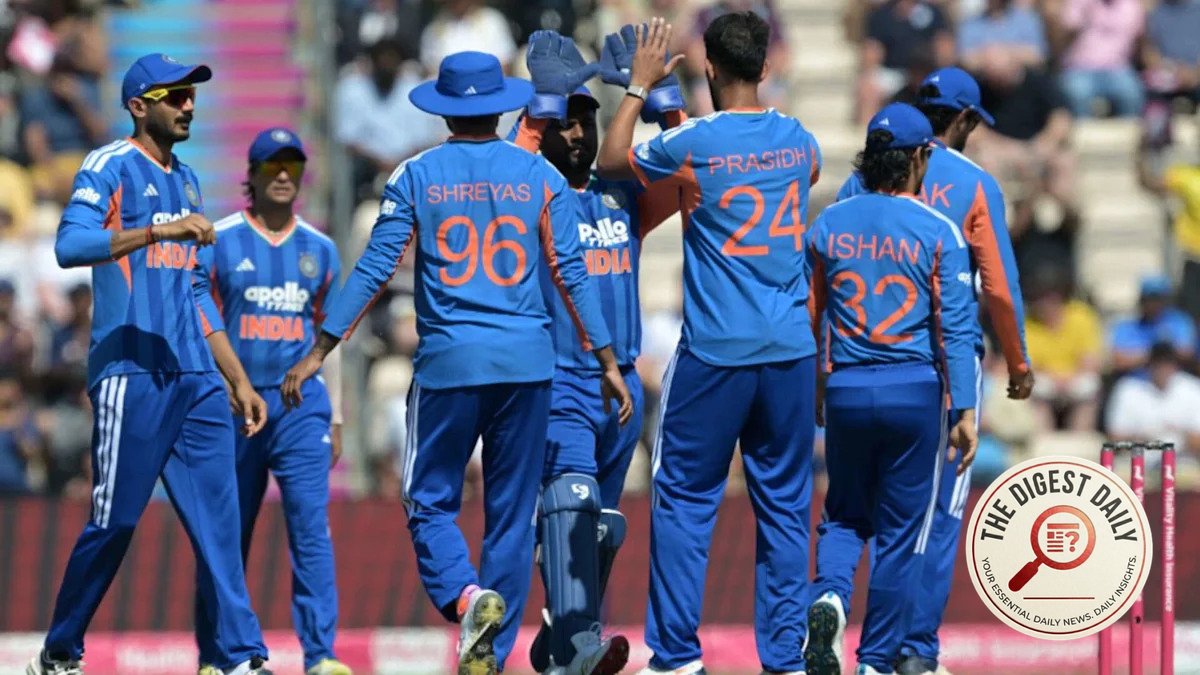
They say a week is a long time in this business. England coach Brendon McCullum muttered the cliché with a smirk after his side completed a ruthless 4-0 demolition of India in Southampton. For the visitors, those two weeks in Ireland and England must have felt like an eternity in purgatory.
Southampton was a sweatbox. The Utilita Bowl offered zero shade for the poor souls baking in the Hotel End. Fans used cardboard placards as makeshift fans, desperately queuing for water under a relentless British sun. Even the logistics failed. The Indian team bus got stuck in a six-mile traffic jam for an hour and a half, delaying the start. It was a fitting prelude to the chaos on the pitch.
Once the game actually started, India’s bowlers served up absolute garbage. Jos Buttler and Harry Brook didn’t just bat; they committing highway robbery. Buttler, who had been averaging a pathetic 15 over his last 14 innings, suddenly looked like a god, smashing a career-best 131. It helped that India’s fielding was utterly toothless. Shivam Dube and Ishan Kishan dropped Brook. The bowling lacked any semblance of a plan. England took 20 or more runs from five different overs. The decision to hand Dube the 19th over was pure desperation. He leaked 22 runs, including a final-ball six that put the game completely out of reach.
This wasn’t just one bad day. It was the final chapter of a disaster class. India arrived in England already licking their wounds from a 2-0 series loss in Ireland. What followed was statistically the worst T20 run in the country’s history. Five straight losses. Their first bilateral series defeat to England since 2018.
In Manchester, the only game where India actually showed a pulse, spinner Ravi Bishnoi repeatedly overstepped from the back foot. He was promptly dropped and never seen again. Then came Trent Bridge, the absolute rock bottom. Chasing a massive target, India collapsed to 76 all out in just 11.4 overs. It was their second-lowest T20 score ever, resulting in a humiliating 125-run defeat. As the players slunk toward the team bus, the traveling Indian fans—who had easily outnumbered the locals—finally snapped. They openly jeered the team, chanting for the ignored Sanju Samson.
In Bristol, the bizarre ground dimensions exposed India’s tactical bankruptcy. Seven of their eight wickets fell to desperate, ugly hooks and pulls against the short ball. England’s blueprint was laughably simple: bowl fast, bowl short, and keep it wide. Jofra Archer and Josh Tongue ran riot. India’s batters, pampered by flat IPL tracks and tiny boundaries back home, looked like rabbits in the headlights. They only tried to adapt in the final game when the series was already dead. Why did it take four straight thrashings to figure that out?
Coach Gautam Gambhir called this a “transition phase.” We’ve heard that excuse before. Back in 2011, right after winning the World Cup, India toured England and got absolutely whitewashed, losing their number-one Test ranking in the process. History is repeating itself, and it points to a deeper rot.
The IPL is killing Indian cricket’s depth. Flat pitches, short boundaries, and the ridiculous “Impact Player” rule mean young players don’t need to develop genuine all-round skills. England has multi-dimensional players like Will Jacks and Sam Curran. India hasn’t produced a single all-rounder of Hardik Pandya’s quality in years. When the going gets tough, this team folds like a cheap tent. Why are proven players like Yashasvi Jaiswal and Shubman Gill sitting on the sidelines when the ball actually moves? Why does the obsession with “mystery” spinners keep traditional match-winners out of the side?
The fans paid premium prices for this garbage. Tickets for the Southampton match were marked up by 25 percent compared to the upcoming Sri Lanka fixture. They sold out nearly a year in advance. What those fans got for their hard-earned cash was a spineless performance. By the end, the sight of dejected Indian supporters streaming toward the exits early was the only consistent thing about the entire tour.