
President Donald Trump is encountering his inaugural political defeat pertaining to the military engagement with Iran. Congressional votes this week aimed at curtailing the military operation could provide Democrats with a significant achievement and underscore the escalating unpopularity of the conflict, even among members of the Republican party.
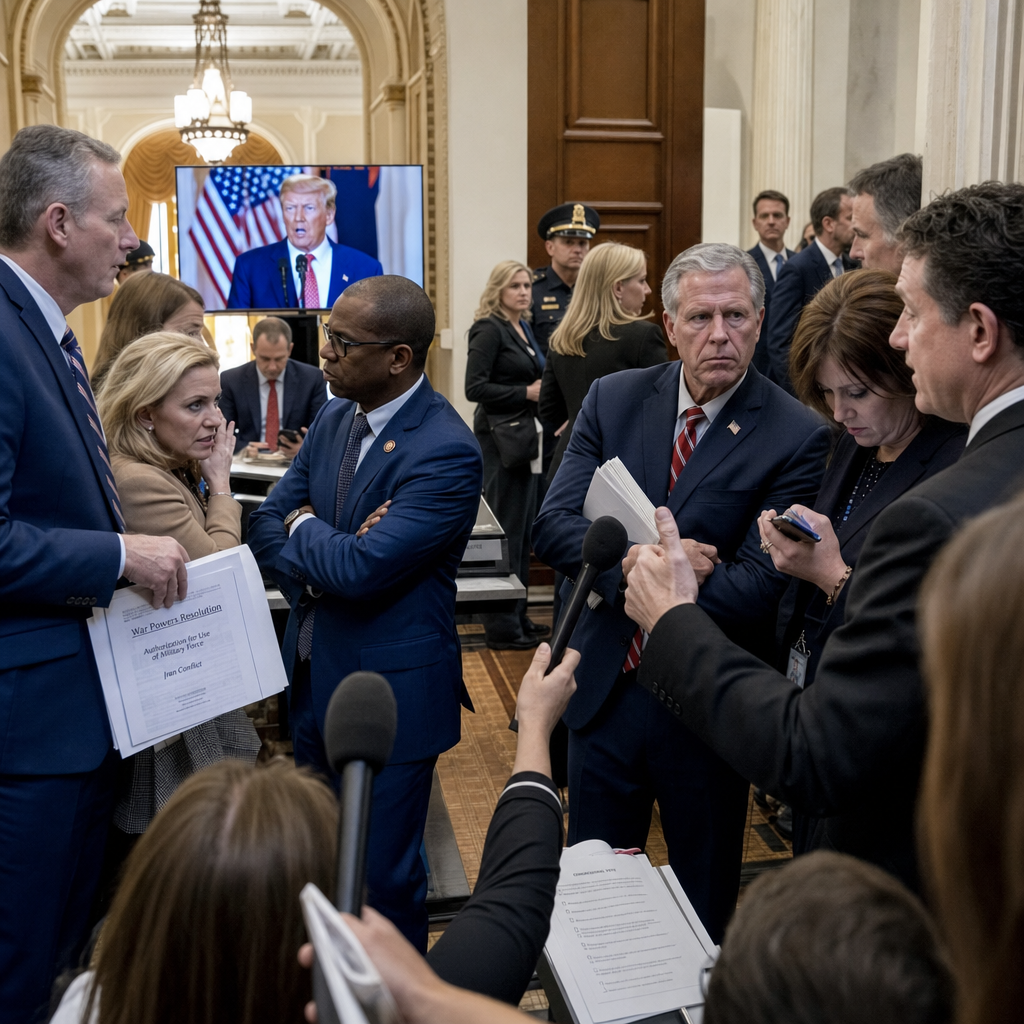
Internal opposition within the President’s party—including two GOP legislators who were recently defeated in primaries with Trump’s involvement—contributed to an initial Democratic success in the Senate on Tuesday, potentially paving the way for a larger victory in the House on Thursday. Legislators had initially scheduled a vote for Wednesday, but multiple defections and absences necessitated a delay.
After almost three months of military involvement with Iran, Trump is poised to face a substantial impediment in the conflict. While primarily a political challenge within Washington rather than a military loss on the front lines, the votes, though largely symbolic due to a probable presidential veto, would represent a notable embarrassment for the President.
Senator Tim Kaine (D-Va.), a key organizer of the legislative effort, commented, “The prevailing narrative today is the increasing momentum among Republican members to assert, ‘You cannot wage this war without our consent.'”
Republican disagreement has intensified as the administration bypasses legal deadlines for ending the conflict and escalating fuel prices negatively impact GOP approval ratings ahead of the midterm elections.
The preliminary Senate vote will compel further debate on the measure within the chamber. However, a more critical vote looms in the House, where it could pass with a joint effort from Democrats and a small number of Republicans.
Final vote counts remain fluid in a closely divided House and during a high-stakes election year. Senate Republicans are anticipated to attempt to sideline the ultimate effort, given that Democrats leveraged GOP absences on Tuesday to advance the measure. Neither chamber has garnered sufficient support to override a presidential veto, which is almost certain if any legislation reaches his desk.
Nevertheless, Democrats contend that the consistent growth in support for war powers limitations—evidenced across eight Senate votes and three House votes—reflects public discontent with the conflict. A New York Times/Siena survey conducted between May 11 and May 15 revealed that 64 percent of Americans perceive the attacks on Iran as an erroneous decision, in contrast to 30 percent who endorse it.
Senator Gary Peters (D-Mich) stated, “Each of our votes tends to attract incrementally more support. A vast majority of the American populace does not endorse this war, so anyone voting otherwise is not in alignment with the sentiment of the American people.”
The Thursday vote follows a tied result last week, despite backing from three House Republicans—Reps. Tom Barrett of Michigan, Brian Fitzpatrick of Pennsylvania, and Thomas Massie of Kentucky. This marks the most significant number of GOP defections since the conflict began.
One Democratic legislator who previously held out, Rep. Jared Golden of Maine, has indicated his intention to support the “clean” war powers measure this week.
Speaker Mike Johnson is expected to campaign against the measure, but the ultimate outcome may hinge on which legislators are present for the vote.
Massie, who has emerged as one of Trump’s most prominent GOP critics, lost his reelection bid on Tuesday to former Navy SEAL Ed Gallrein in Kentucky’s primary. Gallrein ran with Trump’s endorsement, and Defense Secretary Pete Hegseth campaigned for him this week, marking an unusual partisan involvement for a Pentagon chief.
In the Senate, four Republicans voted to curtail the war, including Senator Bill Cassidy, who suffered a decisive primary loss last weekend to a Trump-backed challenger. Cassidy became a target of Trump’s ire after voting to convict him following his impeachment in the aftermath of the January 6 Capitol insurrection.
Critics capitalized on GOP absences to secure Tuesday’s initial Senate vote. Republican leaders will likely endeavor to sideline the war powers measure when full attendance is achieved. However, in another ironic turn, one of the absent Republican senators whose vote will be crucial is Senator John Cornyn (R-Texas), who faced a significant political blow on Tuesday when Trump endorsed his primary opponent.
Regarding Senate relations with the president, Senator Lisa Murkowski (R-Alaska), one of the four Republicans who diverged on the Iran issue, commented, “If today’s atmosphere is indicative, I would say the mood was quite strained. Perhaps he believes he doesn’t need us. But, to my knowledge, laws don’t just materialize on his desk for signing, and funding doesn’t simply appear.”
Senate Republicans who support the conflict largely dismissed the recent vote.
Majority Leader John Thune (R-S.D.) stated, “I don’t think you can infer a great deal from it,” citing the absent senators. Senator Rick Scott (R-Fla.), a member of the Senate Armed Services Committee, characterized the endeavor as “a waste of time.”
However, Senate leaders are unlikely to take final action until after the holiday recess, as noted by Kaine. This provides Democratic legislators a week to publicize their progress to voters and exert pressure on their Republican colleagues to endorse the plan.
Kaine remarked, “They are going to hear a lot from people back home about gas prices and the war. This is gradually leading more GOP members to be willing to tell the President, ‘Hey, Mr. President, you shouldn’t be doing this without us.'”