
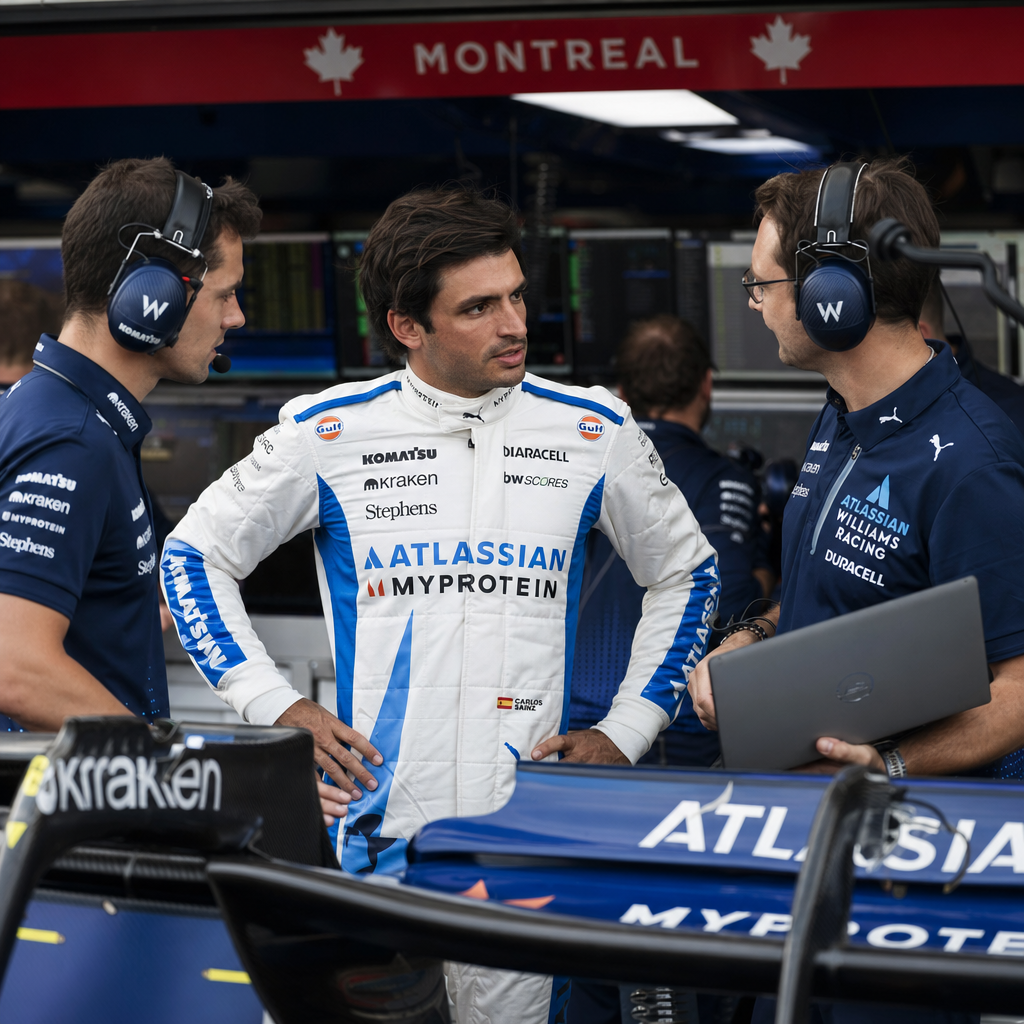
Formula 1 is a sport characterized by relentless evolution, constantly pushing teams and drivers to adapt at astonishing speeds, both on and off the circuit. This intense demand is currently being met by Carlos Sainz Jr. and his Williams team as they approach this weekend’s Canadian Grand Prix.
Williams had high hopes for a strong performance to kick off the year, having dedicated significant resources to the upcoming regulation changes since the previous season. However, initial struggles have seen the team land in eighth place in the standings, amassing a mere five points over four race weekends as they head to Montreal.
Despite this, glimmers of progress are visible at Williams, beginning with the enhancements introduced at the Miami Grand Prix earlier this month. These upgrades enabled both Sainz and his teammate, Alexander Albon, to secure points in Florida. With further improvements slated for Montreal, the team appears to be on an upward trajectory.
Ahead of the Canadian Grand Prix, Sainz shared his thoughts on the season’s commencement, the new Spanish Grand Prix venue, and his vision for a successful 2026 for the team.
**The 2026 Season So Far**
Even with their Miami success, Williams had anticipated a much stronger position on the grid at the outset of the 2026 season. Last year, the team prioritized the impending regulatory framework, aiming to be ahead of the curve when the changes took effect. As Sainz revealed, it has been a “challenging” start for the team.
“It’s definitely been a challenging start to the season,” Sainz admitted. “We all expected quite a bit more from the start of 2026, but unfortunately we’ve hit probably one of the first bumps on the road in our time together, and this has set us back into not being where we would like to be in terms of performance.”
Nevertheless, the team is implementing changes both on and off the track, with some already yielding improved performance. Williams introduced a substantial upgrade package for the Miami Grand Prix, featuring a new floor for the FW48, revised bodywork, modified front wings, a new rear suspension, and even a reduction in the overall weight of their 2026 contender.
Prior to the Canadian Grand Prix, Team Principal James Vowles confirmed that additional upgrades were en route to Montreal. “We have more performance coming from Montreal,” Vowles stated. “It’s an odd situation where we’ve got these two weeks and we want to maximize these two weeks to the best of our ability… the pipeline is a little bit still up in the air as to what we can 100% deliver for that, but there could be a nice sizeable amount of performance.”
Williams indeed brought upgrades to Montreal, which were detailed in their Car Presentation Submission. These included modifications to the front suspension of the FW48 and a repositioned exhaust tailpipe. Off-track, the team announced Piers Thynne was joining the leadership team as the new Chief Optimisation and Planning Officer.
Sainz expressed optimism about the future due to these changes. “Because of that, obviously now there’s a lot of changes going on in the team and quite a big plan to rebuild and react to the things that we know we haven’t done well over the winter, and hopefully it creates a chain of reaction that will actually make things even better in the future,” he remarked.
The discussion then shifted to the new regulation set, which represented the most significant overhaul of technical regulations in Formula 1’s history. The goal was to enhance the racing spectacle, prompting a question about the quality of racing this season from Sainz’s perspective.
“I think there’s been a bit of everything,” Sainz began. “I think it’s been an interesting change for the drivers. It’s challenged us a lot to learn different skills and different ways to drive, on an energy-starved car.”
Despite the challenges, Sainz noted that the cars feel “better” than last year. “I think mainly for me, the cars actually feel quite nice to drive. The aerodynamics and the suspension feel, I would say, even better than last year.”
However, the sport, teams, and governing bodies are actively working to refine aspects. Sainz acknowledged that improvements are underway. “But the PU [power unit] has certainly created some challenges that I’m personally not a big fan of in Formula One, and it’s been probably more challenging than everyone would have anticipated, and because of that, the sport, FIA, and FOM, and the teams are putting together some changes to improve it, and react to what we know is something that is probably not the best solution for F1.”
Looking ahead, Sainz and the rest of the grid will compete at the Madring later this season, the location of the new circuit in Madrid and the new Spanish Grand Prix. Sainz was the first driver to experience the new track alongside Lawrence Barretto, which generated engaging content. He described the new circuit with enthusiasm:
“I think Madrid is gonna be, I hope it’s gonna be, a special, special race,” Sainz said. “I think it’s important that when a new track comes into a calendar that it has character, and it’s different. It’s charismatic. And I think Madrid from the laps I did the other day has quite a bit of that, has very interesting sections of a track with a massive banking corner that ends up in a huge compression that you only see the sky for a bit,” he detailed. “So it has some interesting corners, and I’m hoping the event is gonna run well. We are used to creating or hosting pretty big events during the year. People say that Madrid is a great city, so I’m hoping that people will enjoy it.”
**Focusing on Montreal and Beyond**
The conversation then pivoted to the upcoming Canadian Grand Prix and the remainder of the season. Discussions about the Canadian Grand Prix often begin with the weather, and forecasts indicate potential rain over the weekend, which could impact Sunday’s race. Sainz suggested that such weather would create an “interesting” dynamic under the new regulations.
“It looks right now like Friday and Saturday will be dry, and there’s a chance of rain on Sunday,” Sainz observed. “If there is, I think it’s gonna be quite clear that the rain on Sunday could create a lot of different situations with the new power units, but also I think it would be the first time with these cars in the wet. So if that rain arrives on Sunday, it would be interesting to see.”
This marks the first time the Canadian Grand Prix will feature the F1 Sprint format, with qualifying for the shorter race taking place on Friday after just one hour of practice. Sainz believes the Circuit Gilles Villeneuve’s layout is well-suited for this format. “I think, a sprint is a circuit it suits well, as it’s possible to overtake,” Sainz noted, though he cautioned that “with these new engines also it’s gonna be quite a big challenge on this long straight, so a lot to prepare for.”
Expanding on the challenges the Circuit Gilles Villeneuve will present to drivers with the new regulations, Sainz explained: “It’s very challenging for the driver because you’re always debating whether to push more on the braking or prepare more for the exit of the chicanes. You always run super close to the walls. It’s low grip. There’s quite a bit of sliding so as a driver, there’s a lot of things you need to keep balancing with the add-on this year that we’re also gonna need to be looking at our PU batteries quite a lot in those long straights.” He concluded, “So, yeah, it’s gonna for sure be one of the challenging ones.”
Regarding Williams’ prospects for the weekend, Sainz hopes to contend for points again, mirroring their performance in Miami. “I think we’re coming off the back of more of a positive weekend in Miami where we were certainly performing more [than] at the beginning of the season. We’ve brought a few upgrades to Miami that worked well. We brought another few here which we’re hoping to also be a bit more competitive,” Sainz stated. “I think the combination of these things hopefully will make us fight for the points again here in Canada, and then we will need more of these to come if we want to keep going in the right direction.”
And what does that “right direction” entail for a successful season for Sainz and Williams? In one word: speed.
“I think for me now, it will be a lot about how this season ends, not how it started,” Sainz articulated when asked about a successful season. “So evaluating and seeing the amount of progress that we’re able to do after such a big bump and setback of the start of the season,” the driver continued. “I’m really hoping that we can finish the season strong and show this year resilience to the setback, adapt to the situation, and manage to correct the mistakes. And end the season strongly, not so much caring about the points that we get, the amount of positions we gained through the year, but just being strong at the end of the season, and being fast, and showing that we’ve developed the car a lot. And we’ve become very, very quick.
This mission continues this weekend at the Canadian Grand Prix.