

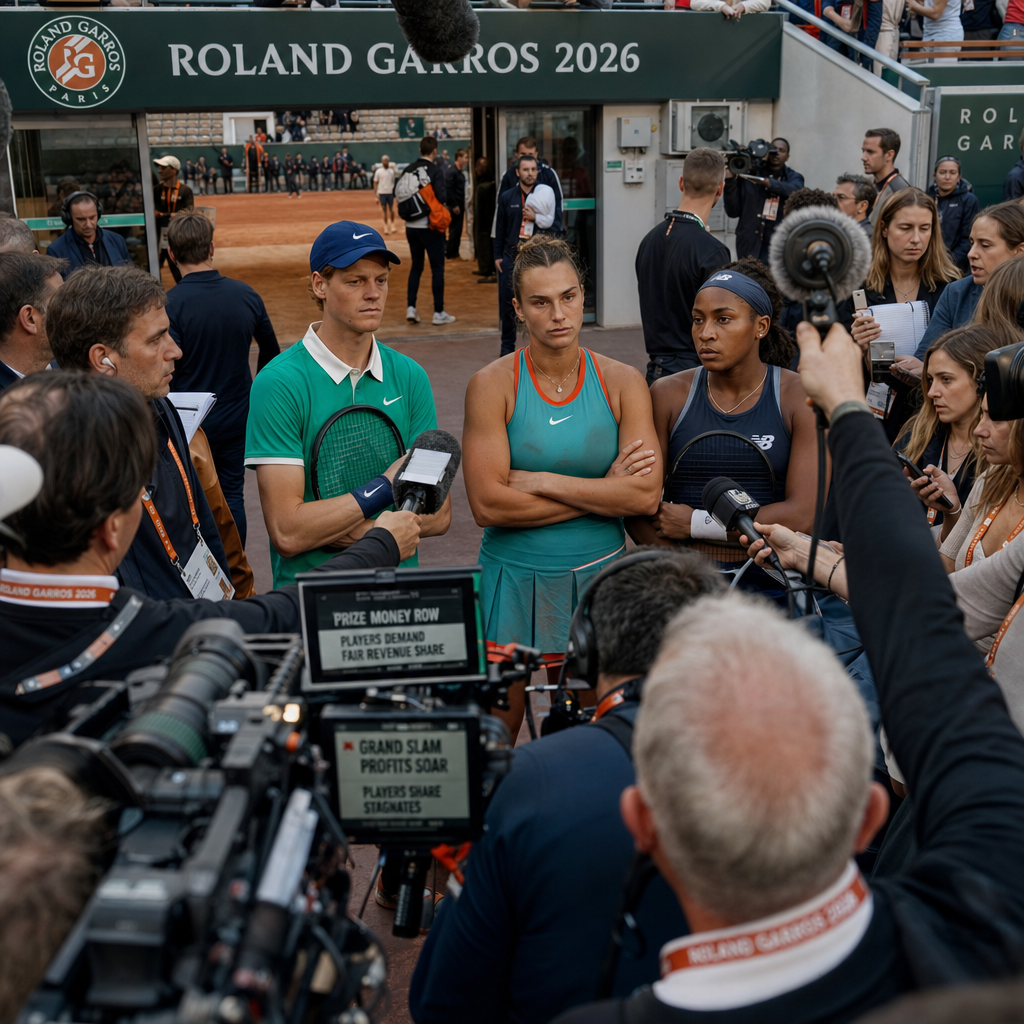
What initially appeared to be a looming player boycott of the 2026 French Open has ultimately softened into a more subdued form of media protest.
Leading figures in this media action include Jannik Sinner, Aryna Sabalenka, and Coco Gauff, who are voicing concerns over Grand Slam prize money distribution and revenue sharing. During the Italian Open, these players hinted at the possibility of a complete withdrawal from the French Open or other major tournaments. This suggestion generated considerable buzz in the media but ultimately did not materialize.
Players are actively participating in this year’s French Open. Unless sidelined by injury or failing to qualify, all ATP and WTA Tour players are present in Paris, competing in matches and earning prize money and ranking points.
However, they are engaging in a media protest, which involves restricting their press interviews to a maximum of ten minutes.
“It’s really about respect, you know? Because I feel we contribute significantly more than what we receive in return,” Sinner stated during an Italian Open press conference. “This isn’t just for the top players; it’s for all of us. And it applies equally to both men’s and women’s tours.”
The players proceeded with this media protest after perceiving an inadequate response to a letter they had previously sent to Grand Slam officials.
“The top ten men and top ten women collaborated on a letter. It’s disheartening that after a year, we haven’t made significant progress on our objectives,” Sinner elaborated. “In other sports, if prominent athletes send important letters, I genuinely believe a response, if not a meeting, would occur within 48 hours. Therefore, I understand why players discuss boycotts, as it signifies a point where we need to take action.”
While at least twenty players support some form of protest, the execution of the non-boycott seemed somewhat disorganized. On Thursday, some journalists expressed surprise to see Gauff participate in the draw ceremony. On Friday, Sabalenka opted for a shorter English-language pre-tournament press conference but still answered questions. Jessica Pegula lightheartedly commented on the ease of enduring briefer press engagements.
During her abbreviated press conference on Friday, Gauff described the media protest as an initial step in a larger process.
“I don’t think this will necessarily create a significant impact immediately for the Slams or this particular tournament. However, I believe it demonstrates that many of us are aligned and are pursuing collective action, rather than just having discussions,” she remarked. “This feels like the first genuine action we’ve taken, and I’m proud that we were all able to reach a consensus.”
**Reasons Behind the Potential Boycott**
Contemporary top tennis players are earning substantially more than their predecessors, with significant income growth observed on the women’s side. Gauff has recently climbed to 11th on the career prize money list. Sabalenka and Iga Swiatek have already surpassed Venus Williams, who began her professional career in 1994 and is still active, in total career earnings.
Major tournaments consistently increase their prize money. The total prize money for the 2026 French Open is set at 61.7 million euros ($72 million), representing a 5.3 million euro ($6.1 million) increase from the previous year, as reported by the ATP Tour. The U.S. Open offered a record $90 million in prize money in 2025.
Players contend that while major tournaments are generating increased revenue, the players’ share remains low compared to the approximately 50% earned by professional athletes in leagues such as the NFL, NBA, and MLB.
Charlie Eccleshare and Ava Wallace of The Athletic reported that a French Tennis Federation (FFT) spokesperson responded to the protest via text message: “We regret the players’ decision, which impacts all of the tournament’s stakeholders: the media, broadcasters, the FFT and the entire tennis community, all of whom follow each edition of Roland-Garros with great enthusiasm.”
Last year, players raised concerns regarding prize money and their overall welfare. They allege that the FFT reduced their share of revenue to 14.9%, down from 15.5% in 2024, and significantly below the standard 22% share at most ATP and WTA events.
**Historical Precedent: A Past Tennis Boycott**
More than five decades ago, Arthur Ashe and ATP President Cliff Drysdale spearheaded a boycott of Wimbledon in response to a labor dispute. Unlike the current limited media engagement, in 1973, 81 players, including 12 of the top 16 seeds, skipped Wimbledon.
This boycott served as a crucial test for the recently established ATP Tour (1972). When Nikki Pilic, representing Yugoslavia, refused to participate in the Davis Cup, his country’s tennis association requested that the International Lawn Tennis Federation (ILTF) ban him from all events, including the French Open.
The ATP players, rallied by icons such as Stan Smith, John Newcombe, and Rod Laver, united in support of Pilic and organized the boycott. This action solidified the ATP’s role as the authoritative voice of the men’s tour.
It remains uncertain whether today’s leading players would be prepared to boycott a Grand Slam.
“Not all players are currently aligned when it comes to the idea of a possible boycott of the French Open,” posted Serena Williams’ former coach Patrick Mouratoglou on Instagram. He also expressed skepticism about Sinner boycotting a Grand Slam.
Could the current generation of top players take a more impactful stand than simply reducing their time with sports journalists?
“That’s a difficult question,” Daniil Medvedev conceded in his pre-French Open press conference. “But I believe that at this moment, you know what we as players desire, and it’s a positive development, as this is likely the first time, at least in my experience on the tour, where players are truly unified.”